How do account adoption, user adoption, and penetration differ?
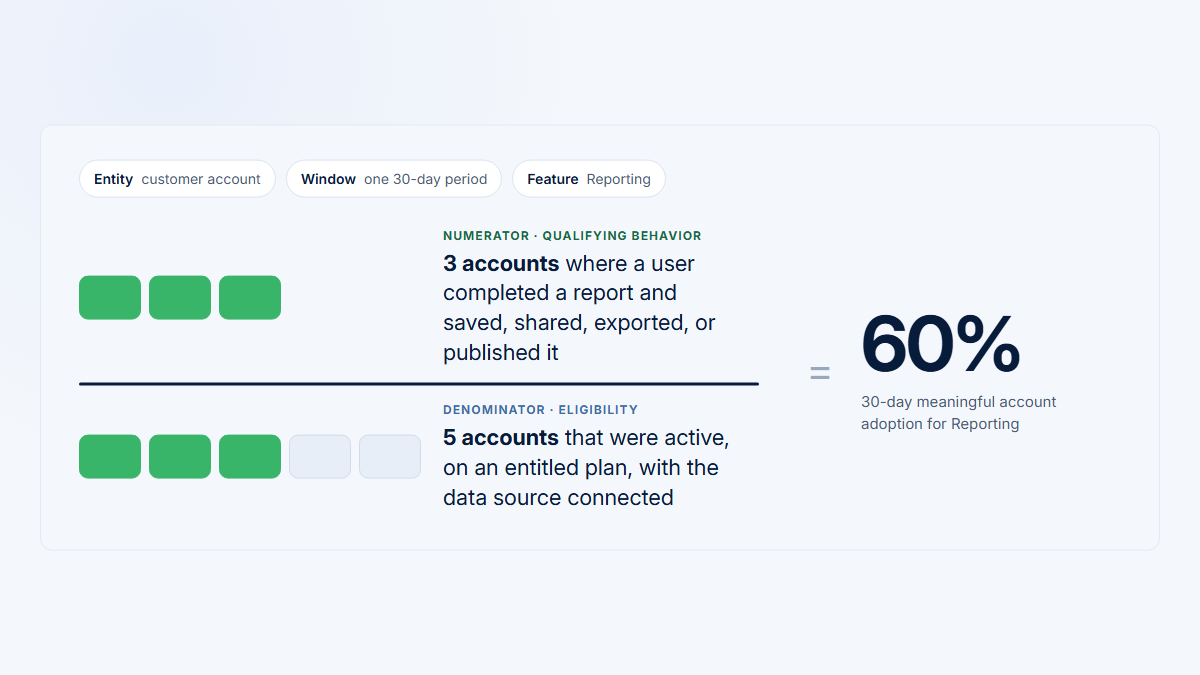
Before calculating any rate, declare the entity, eligibility rule, meaningful behavior, and time window. The percentages are not comparable unless those choices describe the same underlying workflow.
| Metric | Formula | Question answered |
|---|---|---|
| Account adoption | eligible active accounts meeting the threshold / all eligible active accounts x 100 | How many customers reached meaningful use? |
| User adoption | eligible active users meeting the threshold / all eligible active users x 100 | How many eligible people adopted across the portfolio? |
| User penetration | adopting users in adopting accounts / eligible active users in adopting accounts x 100 | Once an account adopted, how broadly did use spread inside it? |
Eligibility matters. A manager dashboard should use active managers in its user denominator; an integration available only on certain plans should use eligible accounts. Invited, disabled, service, or historically inactive users are not automatically real adoption opportunities.
| Specification choice | Example for a discussion workflow | Why it changes the rate |
|---|---|---|
| Entity | Commercial account, workspace, or person | The same behavior can qualify one workspace without qualifying its parent company. |
| Eligibility | Active members with comment permission | All licensed seats would add people who could not realistically participate. |
| Meaningful behavior | Post or reply, not merely open the thread | A page view measures reach while a contribution measures participation. |
| Threshold | Two contributions on two days | A single accidental or support-assisted action does not qualify. |
| Window | Complete 30-day period | A shorter window may miss the workflow's natural cadence. |
The account threshold should reflect the value model. One successful sync may qualify an integration, while a collaborative workflow may require several people to act repeatedly. For denominator and threshold design, see the feature adoption rate guide.
Keep numerator and denominator populations auditable. If an account is excluded because the plan, permission, lifecycle, or prerequisite made the feature unavailable, retain that reason instead of silently dropping the row. That lets reviewers distinguish true behavior change from a changing eligible population.
Which adoption metric should lead?
Use account adoption first when one qualified person can create customer-wide value: configuring an integration, completing restricted security setup, or running a specialist export. Low penetration can be healthy if the workflow repeats at the expected cadence and responsibility is not fragile.
Use user adoption or penetration first when value depends on individual or shared participation: comments, assignments, collaborative reporting, or dashboards intended for a defined role. One active champion should not make a team workflow look fully adopted.
Who has to act for the customer to get the value?
One qualified person can create customer-wide value
Integration setup · restricted security configuration · specialist export
Lead with
Account adoption
Adopting eligible accounts ÷ eligible accounts
Keep as diagnostic
Penetration and top-user concentration — is one person a single point of failure?
Value depends on several people participating
Comments · assignments · collaborative reporting · role dashboards
Lead with
User adoption or penetration
Adopting users ÷ eligible users · adopters ÷ users inside adopting accounts
Keep as diagnostic
Account adoption — how far did the rollout reach across customers?
| Product question | Primary view |
|---|---|
| How many customers reached the feature? | Unweighted account adoption |
| How many eligible people used it? | User adoption |
| How broadly did it spread inside adopting customers? | User penetration by account |
| Does usage depend on one person or customer? | Top-user and top-account concentration, plus backup ownership |
| Did adoption persist? | Repeated use or retention at the relevant entity level |
| How much contracted revenue reached it? | Revenue-weighted adoption, shown beside the unweighted view |
Buying and renewal may happen at account level, but that does not make every feature account-owned. An account-level commercial view and a role-level product view can both be necessary.
What do the four account-and-user patterns mean?
Read account adoption on one axis and penetration on the other. Define high and low against the feature's intended use, eligible population, lifecycle, and a relevant historical or peer baseline; there is no universal benchmark.
Low penetration
High penetration
High account adoption
Most eligible customers reached it
Low penetration
Every customer, one person each
Specialist ownership, shallow rollout, permissions, or champion dependence
Inspect: intended roles, eligible seats, concentration, backup ownership
High penetration
Broad reach, broad participation
Wide rollout — though use may still be mandatory or shallow
Inspect: recurrence, completion, outcomes, segment differences, friction
Low account adoption
Few eligible customers reached it
Low penetration
Barely anywhere, barely anyone
Eligibility, tracking, discovery, setup, relevance, or value may be weak
Inspect: instrumentation first, then onboarding, cohorts, attempted sessions
High penetration
One segment, fully on board
Strong fit in a narrow segment, limited eligibility, or weak discovery elsewhere
Inspect: plan, lifecycle, prerequisites, segment fit, exposure
- Adopting user
- Eligible, did not adopt
- Account that did not adopt
| Pattern | Plausible reading | Inspect next |
|---|---|---|
| High account, high penetration | Broad reach and rollout, though use may still be mandatory or shallow. | Recurrence, completion, outcomes, segment differences, and friction. |
| High account, low penetration | Specialist ownership, shallow rollout, permissions, or champion dependence. | Intended roles, eligible seats, concentration, and backup ownership. |
| Low account, high penetration | Strong fit in a narrow segment, limited eligibility, or weak discovery elsewhere. | Plan, lifecycle, prerequisites, segment fit, and exposure. |
| Low account, low penetration | Eligibility, tracking, discovery, setup, relevance, or value may be weak. | Validate instrumentation first, then onboarding, cohorts, and attempted sessions. |
Do not collapse the matrix into a single “adoption score.” A score can make high account reach and low participation indistinguishable from low reach and high participation. Preserve both axes, the eligible counts behind them, and the account distribution so a team can choose the correct investigation.
Segment before benchmarking. Enterprise and small-business accounts, mature and onboarding cohorts, administrator-only and collaborative workflows, and plans with different entitlements may have legitimately different patterns.
What does a worked B2B example reveal?
The accounts, people, and numbers below are fictional. Assume a 30-day discussion workflow. Eligible active users had permission to comment; a user adopted after posting or replying twice on two days; an account adopted when at least two users met that threshold.
| Account | Eligible users | Adopting users | Qualifying actions | Most active user |
|---|---|---|---|---|
| Ardent Labs | 4 | 3 | 16 | Nia: 8 |
| Beacon Ridge | 6 | 2 | 16 | Omar: 12 |
| Cedar Cloud | 10 | 2 | 10 | Lea: 6 |
| DeltaWorks | 20 | 0 | 0 | None |
| Everfield | 100 | 25 | 160 | Priya: 90 |
| Total | 140 | 32 | 202 | Priya: 90 |
4 / 5 = 80.0% account adoption32 / 140 = 22.9% user adoption32 / 120 = 26.7% penetration inside adopting accounts90 / 202 = 44.6% top-user activity concentration
Versus the prior period, account adoption rose from 60.0% to 80.0%, but user adoption fell from 35.0% to 22.9% and penetration fell from 50.0% to 26.7%. Qualifying actions rose 65.6%. Cedar Cloud crossed the account threshold while Everfield added eligible users, lost adopters, and concentrated activity around Priya.
| Metric | Prior | Current | Reported change |
|---|---|---|---|
| Account adoption | 60.0% | 80.0% | +20.0 percentage points |
| User adoption | 35.0% | 22.9% | -12.1 percentage points |
| Penetration in adopting accounts | 50.0% | 26.7% | -23.3 percentage points |
| Qualifying actions | 122 | 202 | +80 actions, or +65.6% |
For a collaborative feature, the combined story is wider customer reach but narrower participation. It still does not prove failure: verify Everfield's eligibility and permission changes, intended roles, passive value, and whether Priya is a healthy coordinator or a single point of failure.
How should large accounts be weighted?
A global people rate gives every person one vote, so a large enterprise can dominate it. In the example, Everfield supplies 71.4% of the user denominator, 78.1% of adopters, and 79.2% of actions. Excluding it leaves 7 / 40 = 17.5% user adoption.
User-weighted penetration inside adopting accounts is 26.7%. Giving each adopting account equal weight produces (75.0% + 33.3% + 20.0% + 25.0%) / 4 = 38.3%. Neither is universally correct: one describes people; the other describes the average customer.
Identical in both scenarios
12 adopting users
120 eligible users
10% user adoption
6 accounts of 20 users each
Spread across every account
two adopters in each of the six customers
Account adoption
100%
6 of 6 accounts
Concentrated in one account
all twelve adopters inside a single customer
Account adoption
16.7%
1 of 6 accounts
One number, 10% user adoption, covers both. Only the account view tells you whether the feature reached your customer base or one customer.
| View | Use it for | Limitation |
|---|---|---|
| Unweighted account adoption | Customer distribution and rollout reach | A two-person and 2,000-person account receive equal weight. |
| Active-user weighted adoption | Share of eligible people using the feature | Large accounts dominate and can hide weak customer distribution. |
| Revenue-weighted account adoption | Commercial exposure and prioritization | One contract can look broad while few customers adopted. |
Show materially different views under distinct labels. Do not blend them into a composite percentage.
What data model keeps the rates honest?
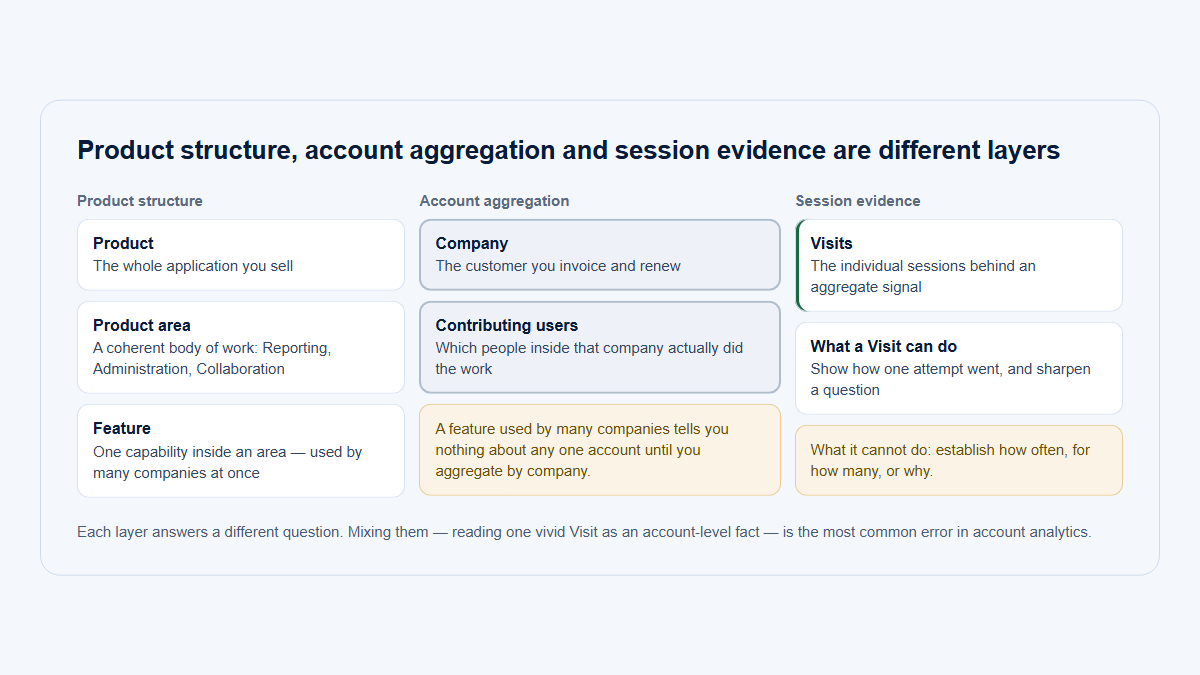
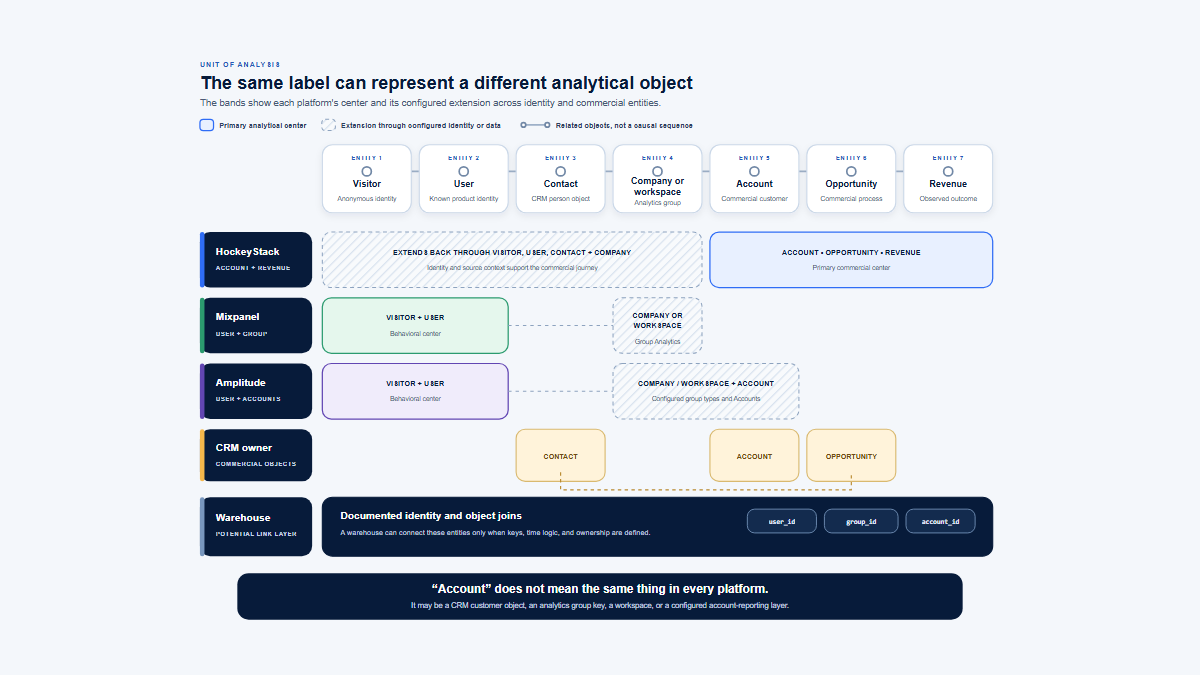
Company, commercial account, workspace, team, and project may be different entities. Use the commercial account for contract exposure, and the operating group for workflows that happen independently inside it. “One of 12 workspaces adopted” is not complete company rollout.
- Preserve the active account or workspace on every event; a user's current default cannot reconstruct historical context.
- Use user-account memberships for penetration because one person can adopt in one context and not another.
- Keep plan, role, permission, lifecycle, and prerequisites available for eligibility.
- Name the grain, behavior, window, and weighting in the metric definition.
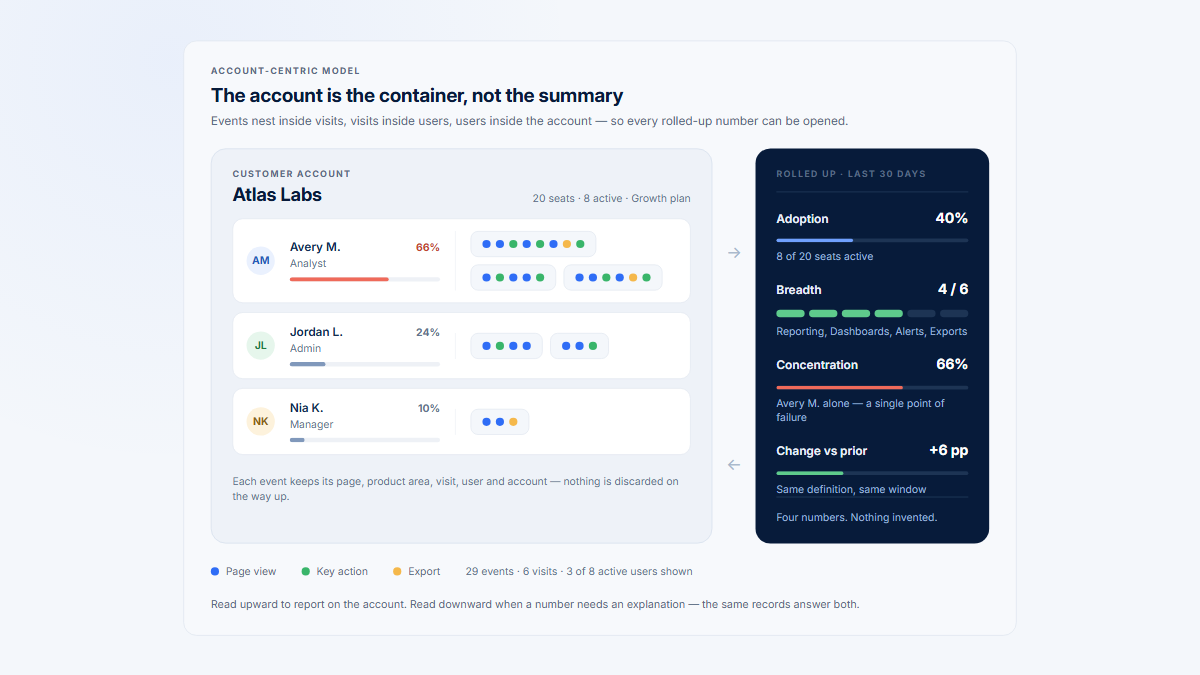
This is why account-centric B2B product analytics separates customer reach, user distribution, concentration, and repeated use.
Which mistakes and next steps matter most?
- One level only: pair global user adoption with unweighted account reach and penetration distribution.
- Wrong denominator: remove accounts and users without realistic access or need.
- One user means adoption: set the account threshold from the value model.
- Different behaviors: do not compare a page-open account rate with a repeated-workflow user rate as if they align.
- Usage equals value: add completion, recurrence, outcome evidence, and qualitative context.
Before publishing the metric, ask whether a reviewer can identify the eligible accounts, reproduce each account's threshold result, trace adopting users to qualifying events, and explain every exclusion. If any answer is no, fix the contract or data lineage before interpreting the rate.
In Hymetry, start with an account signal in Companies, inspect the product area in Pages, identify contributors in Users, and open relevant Visits for session evidence. That path can support both product-team adoption reviews and customer-success account reviews; it does not turn adoption into proof of intent or renewal.
Frequently asked questions
Should B2B SaaS measure adoption by account or user?
Usually both. Lead with the unit that receives value and keep the other as a diagnostic.
Can low user penetration be healthy?
Yes, for intentionally narrow administrator or specialist workflows. It is more concerning when collaboration is part of the outcome.
Can account adoption be higher than user adoption?
Yes. They use different denominators, so compare their pattern rather than ranking the percentages.
Should every licensed seat enter the user denominator?
No. Use eligible active users who could realistically perform the behavior during the window.
How should multi-account users be counted?
Deduplicate people for a global people metric, but use user-account or user-workspace memberships for penetration and preserve event-time context.
Does account adoption predict renewal?
Not alone. It is product-distribution evidence, not proof of satisfaction, value, or renewal intent.
Sources
Methodology and limitations
The definitions, fictional example, calculations, decision framework, and visual concepts are original to this guide. Rates require explicit entity, eligibility, behavior, window, and weighting choices; adoption does not establish causal business outcomes.
Source directory
- Hymetry demo Pages view
- Mixpanel documentation on group analytics
- PostHog documentation on group analytics
- Twilio Segment Group specification
- Twilio Segment Track specification
- Twilio Segment B2B SaaS specification
- Hymetry Pages documentation
- Hymetry Companies documentation
- Hymetry Users documentation
- Hymetry Visits documentation