Choose the deployment boundary
“Open source,” “self-hosted,” and “data ownership” describe different decisions. A product can expose source code while relying on managed infrastructure; a self-hosted deployment can still use third-party cloud services; and running a database does not automatically provide portable schemas or a usable analytics product.
| Model | Team owns | Best fit | Main risk |
|---|---|---|---|
| Managed | Instrumentation, identity, taxonomy, privacy choices, analytical use | Fast learning and limited platform capacity | Vendor limits, data flow, pricing, and portability |
| Fully self-hosted | Collection through UI, security, upgrades, backups, incidents, support | Hard control needs plus existing platform capability | Underestimating application and on-call ownership |
| Warehouse-native | Canonical events, models, transformations, query cost, analytical experience | Teams with mature warehouse and account models | Warehouse tables without interactive product workflows |
| Hybrid | Responsibilities vary by collector, storage, model, UI, or replay layer | Specific boundaries where control and specialization differ | Unclear contracts, duplicated identity, and split incident ownership |
Draw the actual boundary. For each layer, name who operates it, where data moves, how deletion propagates, who receives an alert, and what happens during an upgrade or outage. Hybrid is not one architecture; it is a documented allocation of responsibilities.
The boundary moves; the work does not disappear
Layer
Managed
Fully self-hosted
Warehouse-native
Hybrid
Collection & ingestion
vendor
your team
your team
by contract
Storage & retention
vendor
your team
your team
by contract
Identity & account model
your team
your team
your team
your team
Modeling & taxonomy
your team
your team
your team
your team
Analytical interface
vendor
your team
your team
by contract
Security & privacy controls
shared
your team
your team
shared
Upgrades & backups
vendor
your team
shared
by contract
On-call & incidents
vendor
your team
your team
split — name it
Layers you own
Vendor operates it
Shared — must be written down
Your team operates it
Identity, account model, modeling and taxonomy are yours in every column. No deployment boundary outsources them.
Understand the complete analytics system
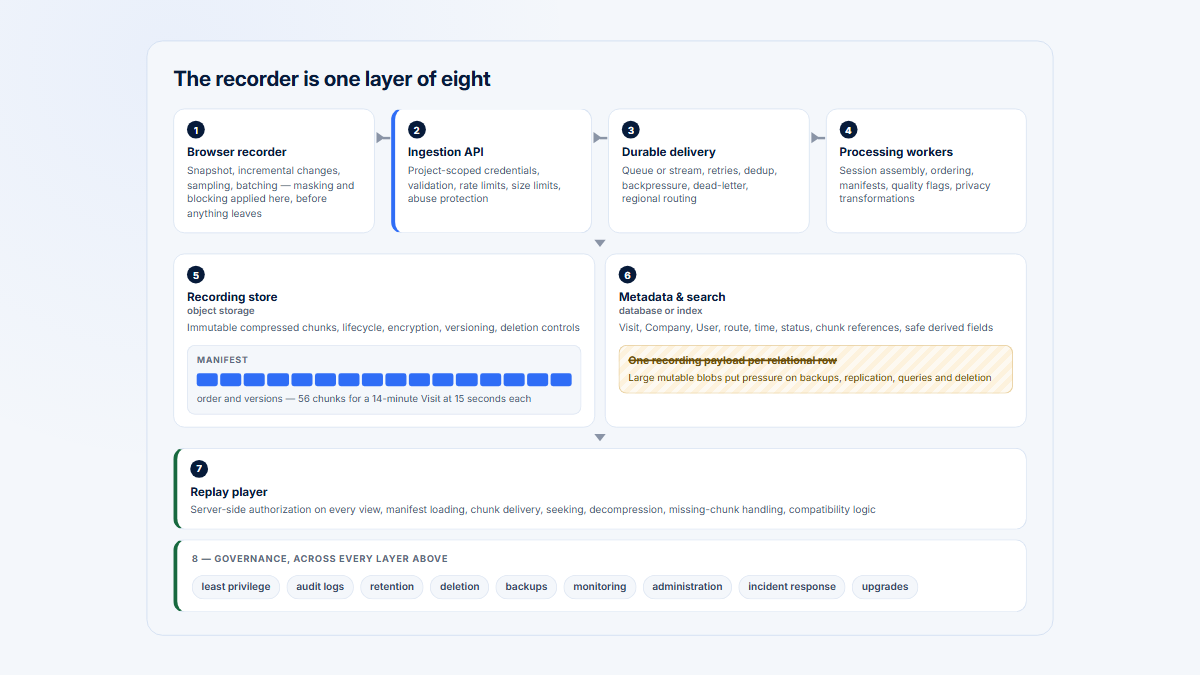
A production system needs more than event storage. Treat the following as one service with explicit data contracts:
- Sources: browser, mobile, server, APIs, imports, and optional replay recorder.
- Ingestion: authenticated project routing, schema validation, rate limits, batching, and privacy filtering.
- Delivery: durable queue or stream, retries, deduplication, ordering rules, timestamps, and backpressure.
- Raw evidence: immutable or append-oriented events with retention and deletion support.
- Identity: anonymous-to-known users, companies, workspaces, membership history, merges, and impersonation.
- Analytical layer: Visits, normalized pages/features, daily or incremental aggregates, and period-level semantic queries.
- Serving: query API, cache, dashboards, exports, permissions, and audit logs.
- Operations: monitoring, data-quality checks, backups, restoration, deployment, incident response, and upgrades.
Replay may share project, user, Company, and Visit IDs, but its recorder, queue, object storage, privacy controls, retention, and playback failures often deserve a separate pipeline.
One service with explicit contracts, plus a second path for replay
Sources
Ingestion — the gate
Analytical path
Delivery
durable queue, retries, dedup, ordering, backpressure
Raw evidence
append-oriented events, retention, deletion support
Identity
anonymous→known, companies, membership history, merges
Analytical layer
Visits, normalized pages, incremental aggregates, period logic
Serving
query API, cache, dashboards, exports, permissions, audit
Replay path separate pipeline
Recorder queue
its own delivery and backpressure
Object storage
chunked recordings, own retention clock
Playback
masking verified, own failure modes
Shared keys only: project · user · Company · Visit
Applies across everything above
Storing events in PostgreSQL, ClickHouse or a warehouse delivers the raw-evidence box only — not identity correction, taxonomy, period logic, permissions or an interface people can use safely.
Design the B2B identity and analytical model
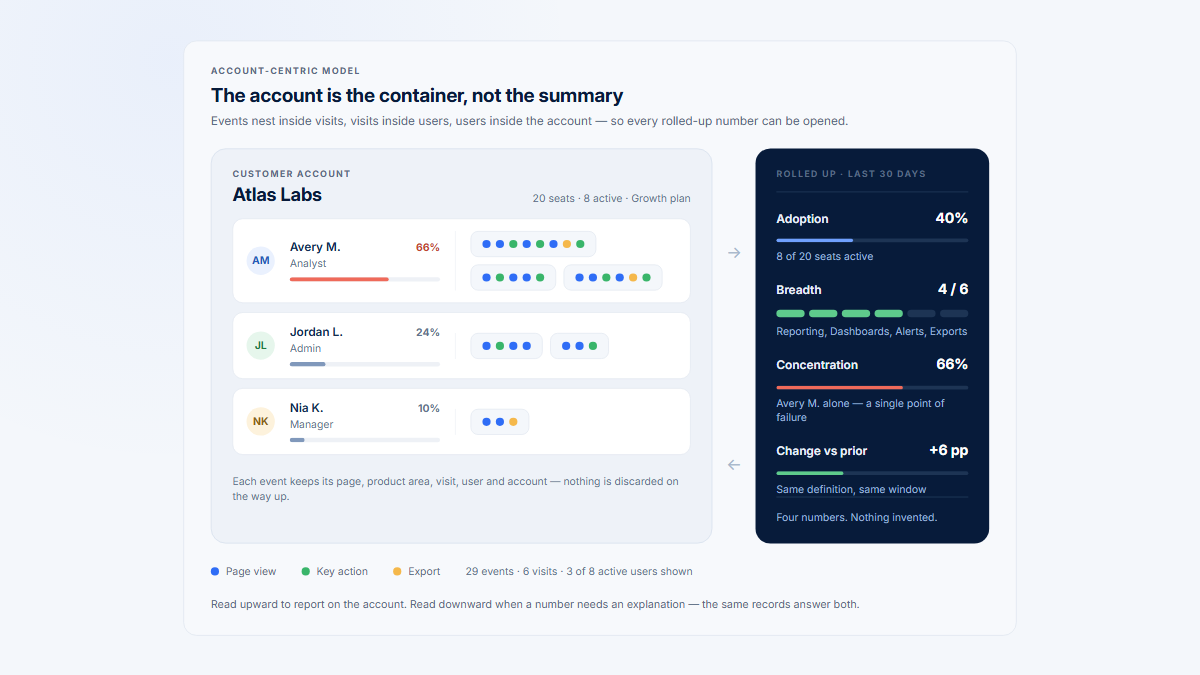
Model stable Users, Companies, workspaces or subaccounts, and time-aware membership. A user may belong to several companies, switch active context, act through support impersonation, or be merged after anonymous use. Preserve company and user IDs on the event when known, plus the membership and attributes needed to interpret history.
{
  "event_id": "evt_01...",
  "occurred_at": "2026-08-04T10:15:00Z",
  "project_id": "project_12",
  "user_id": "user_482",
  "company_id": "company_91",
  "workspace_id": "workspace_7",
  "visit_id": "visit_220",
  "event_name": "report_export_completed",
  "properties": { "report_type": "scheduled" },
  "schema_version": 3
}
Stable IDs are more important than display names. Record membership and company-attribute changes with effective dates when historical analysis needs the context that existed at event time. Label service accounts, bots, staff, test traffic, and impersonated actions.
Maintain a versioned product taxonomy mapping raw routes and events to normalized Pages, grouped features, product areas, and meaningful workflows. Preserve rule history. Moving a feature between areas or changing a meaningful-event rule can create a false trend if the semantic change is invisible.
Use an inspectable intermediate model
An intermediate layer keeps meaning inspectable:
- Raw events preserve evidence and allow reprocessing.
- Visits preserve sequence, identity, and session context.
- Company-period rows support account adoption, breadth, recurrence, and trend.
- User-period rows support role distribution, penetration, and momentum.
- Daily aggregates support fast trends, but daily distinct counts must not be summed into monthly uniques.
- Period-level queries apply current analytical definitions and exact or explicitly approximate distinct logic.
Build for delivery, storage, and query workloads
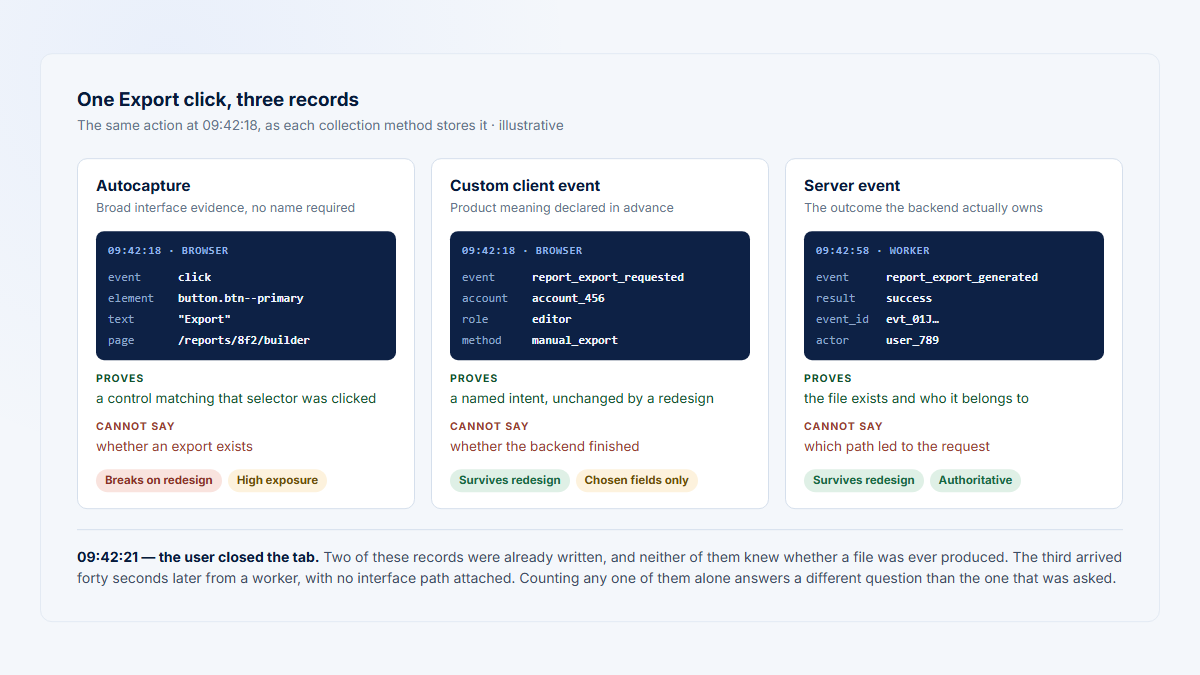
Event ingestion is a delivery system. Batch efficiently, but preserve event identity and source timestamps. Retries create ambiguity after timeouts, so use stable event IDs and idempotent processing. Decide how late and out-of-order events affect Visits and aggregates. Apply schema validation, authentication, project routing, rate limits, internal-traffic rules, and privacy filtering before uncontrolled data spreads.
Choose storage from workloads rather than fashion:
| Workload | Typical need | Design concern |
|---|---|---|
| Raw event retention | Append throughput, partitions, compression, reprocessing | Deletion, late events, and payload evolution |
| Interactive analytics | Fast filters, funnels, cohorts, paths, and distinct counts | Cardinality, concurrency, exactness, and freshness |
| Identity and metadata | Transactions, memberships, rule versions, access | History, joins, tenant isolation |
| Replay | Large compressed chunks plus searchable metadata | Separate privacy, object lifecycle, and player compatibility |
| Cache | Repeated dashboard results | Invalidation, project isolation, eviction |
Partition and index for actual time, project, Company, User, Visit, event, and property filters. Pre-aggregate common grains incrementally, while retaining a path to exact period-level answers. Approximate distinct functions can serve exploratory work only when the UI labels the trade-off. Test high-cardinality properties and skewed enterprise accounts explicitly.
Own reliability, security, and privacy
Define service indicators across the path: accepted and rejected events, queue age, retry and duplicate rates, late-event delay, transformation failures, Visit completion, aggregate freshness, query latency and errors, cache behavior, export success, deletion backlog, backup age, restoration results, deployment failures, and tenant-isolation tests.
Security responsibilities include encryption in transit and at rest, project and tenant isolation, least privilege, server-side authorization, SSO/MFA where required, audit logs, secret management, environment separation, vulnerability management, dependency updates, backup protection, and incident response. Minimize collection before storage; masking downstream does not undo unnecessary capture.
- Document recovery time and recovery point objectives.
- Test restoration, not only backup creation.
- Authorize every dashboard, export, and replay lookup by project.
- Propagate retention and deletion through raw events, aggregates, indexes, caches, exports, and backups according to policy.
- Monitor privacy and taxonomy regressions after releases.
- Assign an on-call owner and escalation path before launch.
Self-hosting does not guarantee privacy or control. Poorly scoped credentials, broad database access, incomplete deletion, unpatched dependencies, and untested backups can make a self-hosted system less safe than a well-governed managed one.
Calculate capacity and total cost
Total cost includes infrastructure, engineering, analytical UX, data quality, security, privacy, compliance, support, governance, incidents, and opportunity cost. Managed services allocate some of these costs to a subscription; self-hosting makes more of them internal.
The same cost categories, allocated differently
Cost category
Managed
Self-hosted
Infrastructure
Engineering & on-call
Analytical UX
Data quality
Security, privacy, compliance
Support & governance
Opportunity cost
Paid through a subscription line
Internal cost — still real, rarely invoiced
Illustrative Team B capacity — planning figures, not guarantees
Events per day
18,000 DAU × 45 events
810,000/day
Peak design baseline
1,500 concurrent × 0.35/s
525events/s
Raw retained, 730 days
650 B × 810k × 730 × 2 copies
769GB
Replay retained, 30 days
1.2 MB × 3,000/day × 30 × 2
216GB
Aggregate rows
4 projects × 20k keys × 6 grains
480,000rows/day
Aggregate rows over 730 days, if every combination is retained
350.4million rows
Every figure above is “before”: add indexes, metadata, queues, temporary space, logs, exports, cache, backups, object versions, compression variance, retries and headroom. Model averages and peaks separately.
Events per day = active users × events per active user per day

Peak events per second = peak concurrent users × events per active user per second

Raw retained data = compressed event size × events per day × retention days × retained-copy factor

Aggregate rows per day = projects × active entity keys × analytical grains

Replay retained data = compressed recording size × recordings per day × replay retention days × retained-copy factor
These are planning formulas, not guarantees. Add indexes, metadata, queues, temporary space, logs, exports, cache, backups, object versions, compression variance, retries, and headroom. Model averages and peaks separately.
Decide with a production-like pilot and exit plan
Self-hosting is plausible when hard deployment boundaries, long retention, custom account modeling, high customization, predictable scale, and existing data/platform operations justify ownership. Managed analytics is often better when a team needs rapid learning, polished workflows, limited infrastructure responsibility, and no hard requirement ruling out a provider. Warehouse-native and hybrid patterns fit teams with durable internal models but specific UI or replay needs.
Three fictional teams illustrate the fit:
- Team A: 600 daily users, no data team, early learning. Start managed, keep event and identity contracts portable, and reassess later.
- Team B: 18,000 daily users, strict data location, custom accounts, long retention, existing platform on-call. Self-hosted or hybrid is strategically plausible after a failure-oriented pilot.
- Team C: 8,000 daily users and mature warehouse models but limited appetite for another application stack. Warehouse-native structured analytics plus a managed or narrow replay/UI layer is likely.
Test peak ingestion, retries, duplicates, late events, account filters, high-cardinality properties, Visit construction, exact distinct counts, replay, concurrent dashboards, retention, deletion, backup restoration, upgrades, failures, and on-call response.
Plan exit before adoption: raw export, documented schemas, stable IDs, membership history, taxonomy versions, replay compatibility, extension inventory, deletion behavior, parallel run, result-parity tests, rollback, and an owner. A durable event and identity model independent of one UI is the strongest protection against lock-in.
How Hymetry approaches self-hosted analytics
Hymetry connects Pages, Companies, Users, and Visits through stable B2B context. Hosted plans start at $149/month with infrastructure managed by Hymetry. Self-Hosted Pro is $199/month for the full commercial software, including email reports and access to commercial updates. Free Open Source Core provides essential analytics and recordings with code available to inspect and customize.
- Both self-hosted editions require your team to manage installation, infrastructure, storage, backups, and updates.
- Pro deployments are arranged through contact. Hardware and configuration determine capacity; enabled external integrations can send data to your chosen providers.
For Open Source Core, review the repository and AGPL terms for deployment and modification obligations; this guide does not provide legal advice. Validate the current code, supported infrastructure, migration path, and operating ownership in a production-like environment.
Frequently asked questions
Is open-source product analytics free?
The license may have no subscription fee, but infrastructure, engineering, data quality, security, upgrades, support, and incidents remain costs. Review license obligations separately.
Does self-hosting guarantee data ownership or privacy?
No. Control depends on architecture, credentials, contracts, collection scope, access, retention, deletion, backups, dependencies, and operating discipline.
Can PostgreSQL alone support product analytics?
It can store and query many workloads, but a complete product also needs collection, identity, modeling, performance design, UI, governance, and operations. Scale and query shape determine fit.
When is warehouse-native analytics a better fit?
When the warehouse already holds durable account, user, membership, and business models and the team can build or buy the required interactive experience.
How many events justify self-hosting?
No universal count does. Control requirements, existing capability, query patterns, retention, staffing, and total cost matter more than one volume threshold.
Can daily aggregates be used for longer periods?
For additive measures, often. Do not sum daily distinct users or accounts to get monthly uniques; calculate distinct entities across the complete period or use an explicitly approximate method.
Should events and replay use the same pipeline?
They can share identity and Visit context, but separate queue, storage, retention, privacy, and failure handling are often safer because replay has different volume and sensitivity.
What most reduces lock-in?
Portable raw events, stable IDs, documented schemas, membership history, versioned taxonomy, export, and result-parity tests independent of the presentation layer.
Sources
Source review date: 4 August 2026. Hymetry pricing and deployment information updated 26 October 2026. Hymetry functionality, documentation, repository route, deployment notes, license, and source URLs were re-verified for publication.
Hymetry and licensing
Collection and event pipelines
Storage, aggregation, and query design
Cost, security, privacy, and replay
Additional references from the original article
- clickhouse.com: Incremental Materialized View
- clickhouse.com: Choosing A Primary Key
- clickhouse.com: Partitioning Keys
- AWS: Versioning
- AWS: Cost Select Service Thorough Analysis
- csrc.nist.gov: Final
- csrc.nist.gov: Final
- csrc.nist.gov: Final
- OWASP: Logging Cheat Sheet
- OWASP: Authentication Cheat Sheet
- OWASP: Cryptographic Storage Cheat Sheet
- How to Analyze Product Usage by Company