Key differences
| Criterion | Google Analytics 4 | Matomo | Plausible Analytics |
|---|---|---|---|
| Primary model | Events, users, and sessions | Visitors, visits, actions, events, and goals | Aggregate pageviews and custom events with daily visitor estimation |
| Best for | Google-centered marketing and ecommerce | Broad analytics plus deployment control | Focused public-site reporting |
| Attribution | Advanced models and Google Ads workflows | Core attribution plus premium multi-channel capability | Source and campaign reporting; not advanced multi-touch |
| Funnels and retention | Funnels, cohorts, lifetime, and stickiness | Cloud or premium On-Premise packages | Hosted funnels by plan; no persistent cross-day cohort model |
| Replay and heatmaps | No native capability | Cloud included; premium On-Premise capability | No native capability |
| Data access | BigQuery raw-event export and APIs | APIs, direct On-Premise database, paid Cloud connector | Aggregate API/CSV, Enterprise raw exports, Community ClickHouse |
| Self-hosting | No | Yes | Yes, Community Edition |
| Cookies | First-party identifiers by default | First-party cookies by default; cookieless configuration available | No cookies or persistent browser IDs in the standard model |
| Company analytics | No native company entity | No native company entity | No native company entity |
Decision by scenario
| Scenario | Start with | Why | Alternative when |
|---|---|---|---|
| Google Ads and ecommerce | GA4 | Advertising audiences, attribution, ecommerce schemas, and BigQuery | Choose Matomo when deployment control or native replay dominates |
| Detailed privacy-conscious web analytics | Matomo | Visitor analysis, campaigns, ecommerce, replay, and hosting choice | Choose Plausible when the smaller model is sufficient |
| Small company website | Plausible | Focused dashboard, goals, campaigns, and simple pricing | Choose Matomo for visitor reports, replay, or deployment control |
| Self-managed infrastructure | Matomo On-Premise or Plausible Community | Both can run on your infrastructure | Choose by analytical breadth and operating capacity |
| Raw marketing event warehouse | GA4 | Native BigQuery export | Evaluate schema gaps, limits, and cloud cost |
| Authenticated B2B SaaS adoption | Separate product/account layer | None has a native customer-company adoption model | Keep one of these for public-site acquisition |
Data model and analysis depth
GA4 turns page views, clicks, purchases, signups, and other interactions into events with parameters, then layers users and sessions over that stream. Its flexibility supports sophisticated acquisition and ecommerce work but makes event naming, key events, campaign governance, consent, and reporting expertise decisive.
Matomo exposes visitors, visits, actions, events, goals, ecommerce, and optional authenticated User ID. It offers richer visitor-level history than Plausible, plus funnels, cohorts, heatmaps, recordings, and A/B testing depending on Cloud or On-Premise packaging. That breadth requires decisions about identifiers, retention, anonymization, cookies, consent, and access.
Plausible uses a daily aggregate identity
Plausible deliberately avoids persistent visitor profiles. Its documented model generates a daily identifier from a rotating salt, domain, IP address, and User-Agent; the salt is deleted every 24 hours, while raw IPs and full User-Agent strings are not stored.
A returning person cannot be recognized as the same persistent profile by that mechanism. This is useful when aggregate traffic and conversion questions are enough, but it cannot answer multi-week user retention or account adoption.
Privacy, deployment, and data export
“Cookie-free” and “self-hosted” are technical descriptions, not universal legal conclusions. GA4 normally uses first-party analytics cookies, with collection affected by Consent Mode and configuration. Matomo uses first-party cookies by default and can be configured for cookieless tracking with documented limitations. Plausible’s standard model uses neither cookies nor persistent browser identifiers. The complete implementation, purpose, jurisdiction, and surrounding systems still determine obligations.
GA4 runs on Google-operated infrastructure. Matomo Cloud documents primary data in Frankfurt and backups in Dublin; On-Premise location is chosen by the operator. Plausible documents EU processing and storage for Cloud, while Community Edition location is chosen by its operator.
Managed operation
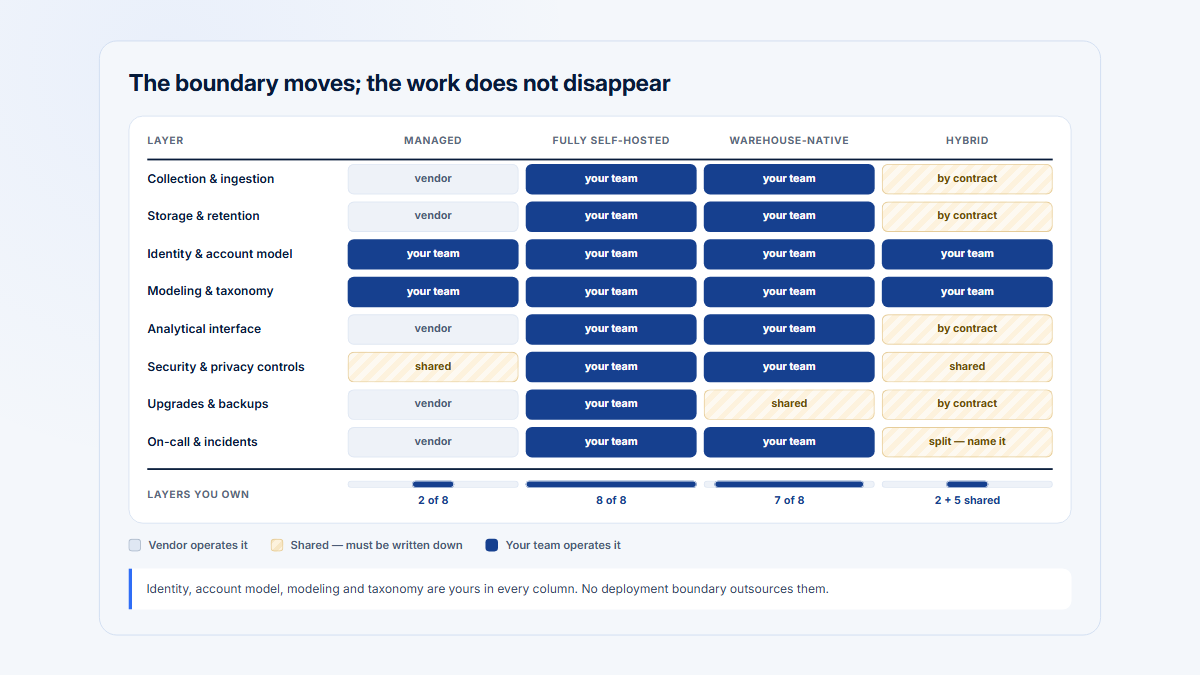
GA4 and the hosted editions remove server operations but do not remove implementation, governance, consent, access, retention, or cost review. BigQuery, Matomo’s Cloud connector, and Plausible Enterprise exports each have distinct schemas and limits.
Self-hosted operation
Matomo On-Premise requires database sizing, archive processing, cron jobs, backups, monitoring, upgrades, plugin compatibility, PHP and database maintenance, security, and capacity planning. Plausible Community still requires PostgreSQL, ClickHouse, application services, releases, backups, monitoring, security, and capacity.
Pricing and customer ratings
Google Analytics 4
Standard: $0 hosted. Analytics 360 is contract-priced; a base fee covers the first 25 million monthly billable events, followed by volume tiers.
Include implementation, tag governance, reporting expertise, and separate BigQuery storage and query cost.
Matomo
Cloud: approximately USD $26 monthly for 50,000 hits in the machine-readable reference; the locale UI showed €22 monthly or €220 yearly.
On-Premise Community software is free, excluding infrastructure and operations. Premium modules and bundles add cost; reconcile the live options before buying.
Plausible
At 10,000 monthly pageviews with annual billing: Starter $9, Growth $14, and Business $19 monthly equivalents. Enterprise is custom.
Community Edition software is free, excluding infrastructure and operations; hosted funnels and exports differ by plan.
Prices are an August 6, 2026 snapshot, not a promise. Recheck currency, tax, billing period, usage unit, retention, exports, modules, and operational cost.
Google Analytics
Approximately 6,851 reviews. The listing covers “Google Analytics” and must not be described as 6,851 GA4-only reviews.
Matomo
Approximately 96 reviews.
Plausible Analytics
Approximately 4 reviews—far too few for a reliable market-wide comparison.
Which should you choose?
| Choose | When it is the strongest fit | Validate before signing |
|---|---|---|
| Google Analytics | You need acquisition measurement within Google’s advertising, tagging, reporting, and BigQuery ecosystem. | Consent behavior, attribution limits, data thresholds, retention, exports, and whether 360 is actually required. |
| Matomo | You want fuller web analytics with a self-hosted path or more direct control over deployment and stored data. | Hosting and upgrade ownership, paid modules, scale, privacy configuration, and support cost. |
| Plausible | A small team values a focused traffic dashboard, simple goals, and lower implementation or governance overhead. | Required segmentation, attribution, ecommerce, exports, team access, and traffic-tier pricing. |
Decision rule: choose for the measurement job and operating model, then validate with the same consent states, campaigns, goals, exports, and monthly traffic—not with headline privacy or price claims alone.
Where Hymetry fits
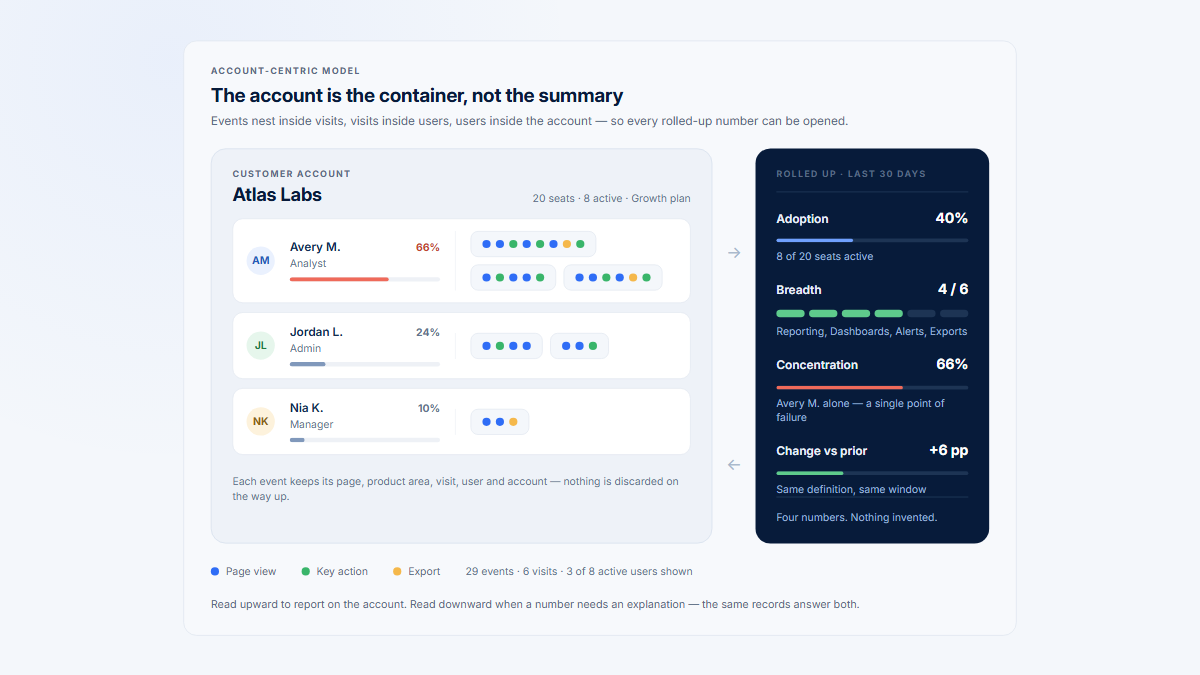
Hymetry does not replace GA4, Matomo, or Plausible for public-site traffic, acquisition, attribution, or advertising. It becomes relevant after signup, when identified Users belong to customer Companies and teams need adoption by product area, grouped Pages, workflow, and the Visits behind a signal.
A common architecture uses one of these tools for the public website and Hymetry for authenticated B2B product usage. Hymetry is newer, narrower, has a smaller ecosystem, and lacks a mature independent rating sample. It is not a marketing-attribution platform and does not have an advertising ecosystem comparable with Google.
Frequently asked questions
Is Matomo better than Google Analytics?
Matomo is better when deployment control, direct data access, visitor reports, and native replay matter more. GA4 is better when Google Ads, ecommerce, attribution, app measurement, and BigQuery are central.
Is Plausible better than GA4?
Plausible is better for a small aggregate-first website dashboard. GA4 is better for sophisticated acquisition, advertising, ecommerce, persistent-user analysis, and raw-event export.
Which is best for ecommerce?
GA4 is normally strongest for detailed ecommerce schemas, product reports, checkout journeys, Ads, and BigQuery. Matomo is strong when ecommerce must combine with deployment control or replay. Plausible Business suits lighter revenue and funnel analysis.
Which can be self-hosted?
Matomo On-Premise and Plausible Community Edition can be self-hosted; GA4 cannot. Self-hosting does not make infrastructure, security, maintenance, privacy, or compliance automatic.
Which supports session replay?
Matomo supports replay and heatmaps through Cloud or premium On-Premise packaging. GA4 and Plausible do not provide native replay.
Which is best for an authenticated SaaS app?
GA4 or Matomo can collect authenticated events, but neither has a native multi-user customer-company adoption model. Plausible avoids persistent identified-user tracking. Use a dedicated product or account analytics system for those questions.
Sources
Disclosure: Hymetry publishes this comparison and is mentioned only where authenticated B2B product usage is relevant. Product capabilities, prices, ratings, licensing, deployment guidance, and videos were verified against linked sources and may change after publication.
The comparison does not claim hands-on testing of the three products against a shared dataset. Google, Matomo, Plausible, G2, YouTube, and the independent publishers cited here are not represented as endorsing this article.
Legal-context boundary
Privacy, consent, data-protection, communications, employment-monitoring, and sector-specific requirements depend on implementation and jurisdiction. This article describes documented technical and operational characteristics and is not legal advice.
Methodology: Desk research and implementation-time verification were completed on . Official product, pricing, event, identity, export, privacy, deployment, licensing, and repository sources took priority; G2 supplied one shared ratings source; independent reviews and videos challenged the decision structure. No hands-on comparative test is claimed.
Google Analytics official sources
Matomo official sources
Plausible official sources
Ratings and video sources
Additional references from the original article
- Google Support: 12923437
- Google Support: 9267744
- Google Support: 12229528
- Google Support: 9358801
- Google Support: 13128484
- Google Support: 7667196
- Google Support: 13644080
- Google Support: 11161109
- Google Support: 9013858
- Google Support: 12979939
- Google Support: 10632359
- Google Support: 9379420
- Google Developers: Cookies
- Google Support: 12017362
- Google Support: 16871531
- Google Support: 17016975
- Google Support: 13722168
- Google Support: 9940393
- Matomo: Pricingforai
- Matomo: Data Warehouse Connector
- Matomo: How Much Does The Bigquery Export For Matomo Cloud Cost
- Matomo: Matomo Analytics Licences For Core Tracker And Plugins
- Matomo: Ecommerce
- Matomo: What Is Campaign Tracking And Why It Is Important
- Matomo: Faq 168
- plugins.matomo.org: Funnels
- plugins.matomo.org: Ab Testing
- plugins.matomo.org: Custom Reports
- plugins.matomo.org: Form Analytics
- plugins.matomo.org: Cohorts
- plugins.matomo.org: Multi Channel Conversion Attribution
- plugins.matomo.org: Advertising Conversion Export
- plugins.matomo.org: Login Saml
- Matomo: Tracking Api
- Matomo: Faq 156
- Matomo: Configure Privacy Settings In Matomo
- Matomo: Faq 24536
- Plausible: Subscription Plans
- Plausible: Metrics Definitions
- Plausible: Goal Conversions
- Plausible: Custom Event Goals
- Plausible: User Journeys
- Plausible: Stats Api
- Plausible: Events Api
- Plausible: Export Stats
- Plausible: Data Pipelines
- searchlab.nl: Google Analytics 4 Vs Matomo
- narratiq.fr: Plausible Vs Ga4 Vs Matomo
- adastramarketing.website: Ga4 Vs Matomo Vs Plausible 2026
- faurya.com: Matomo Vs Plausible
- openpanel.dev: Self Hosted Web Analytics
- Plausible: Vs Matomo
- Matomo: Plausible Vs Matomo
- product analytics tools comparison
- product usage by company
- grouping dynamic SaaS URLs
- page views, Visits, sessions, and engaged time