Key differences
| Criterion | PostHog | Matomo | Plausible |
|---|---|---|---|
| Primary job | Product analytics and product-building workflows | Full web and digital analytics | Simple website analytics |
| Identity model | Anonymous and identified people; optional groups | Visitors, visits, optional User ID, custom dimensions | Aggregate daily visitors without persistent profiles |
| Funnels and retention | Strongest product depth | Funnels and cohorts through Cloud/premium features | Hosted-plan funnels and journeys; no retention analysis |
| Session replay | Native | Cloud or premium On-Premise feature | Not available |
| Flags and experiments | Native flags and experiments | Paid A/B Testing capability | Not an experimentation platform |
| Acquisition and ecommerce | Possible, but not the center | Deepest | Focused traffic, goals, and hosted ecommerce reports |
| Self-hosting | Unsupported open-source deployment path | Most mature Community and commercial options | Community Edition |
| Hosted billing unit | Separate product usage meters | Hits | Page views plus custom events |
| Main trade-off | Technical and pricing complexity | Operational/module complexity | Deliberately limited analysis depth |
Three scopes, overlapping but not interchangeable
Plausible
Simple website analytics
Matomo
Full web analytics
PostHog
Product and engineering analytics
Editorial model, not a benchmark. They overlap on traffic reporting and diverge sharply on what else the platform is expected to do — and on who is expected to operate it.
Decision by scenario
| Scenario | Start with | Why | Qualification |
|---|---|---|---|
| Public marketing site | Plausible | Small dashboard and simple implementation | Use Matomo when attribution, visitor detail, or ecommerce is deeper |
| Authenticated SaaS product | PostHog | Identity, events, funnels, retention, replay, and groups | Keep a stable event and account model |
| Enterprise web estate | Matomo | Broad web reporting and deployment options | Model modules, hit volume, and governance effort |
| Self-hosting with commercial support | Matomo | Mature On-Premise packages and services | Infrastructure remains your responsibility |
| Minimal self-hosted traffic dashboard | Plausible Community Edition | Narrower scope and open-source edition | Hosted and Community features are not identical |
| Engineering-led all-in-one stack | PostHog | Analytics plus replay, flags, experiments, and data tooling | The OSS deployment is not Cloud-equivalent support |
| Marketing plus product measurement | Separate tools | Each job gets the right data model | Define identity handoff and KPI ownership |
Analytics and identity model
The decisive distinction is what the product treats as a durable analytical entity.
| Question | PostHog | Matomo | Plausible |
|---|---|---|---|
| Core unit | Events tied to anonymous or identified people | Hits organized into visits and visitor histories | Aggregate page views, events, and estimated daily visitors |
| Known users | Identify links behavior to a person profile | Optional User ID can connect visits | No persistent individual profile |
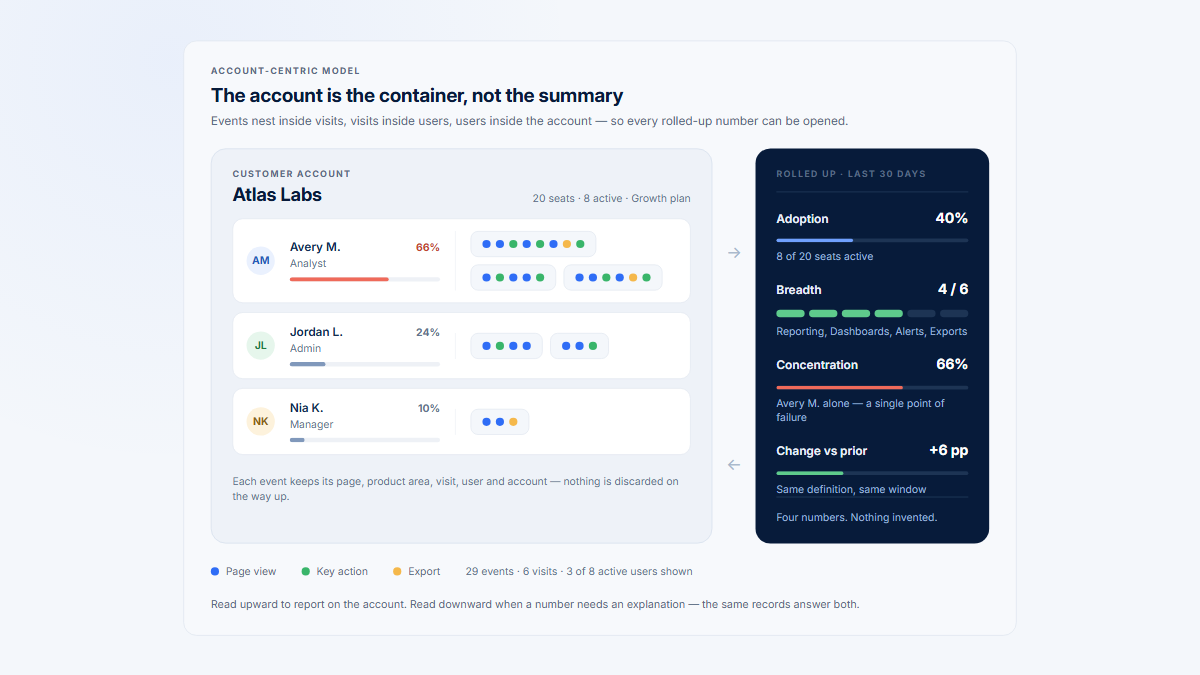
| B2B accounts | Paid Group Analytics | Custom dimensions and reporting design | Custom properties can segment events; no native account entity |
| Historical behavior | Funnels, retention, paths, cohorts, replay | Visitor logs, goals, funnels, cohorts, flows, replay by package | Aggregate periods, hosted funnels, and journeys |
| Authoritative outcome | Server event or imported source | Tracking API or authoritative integration | Custom event sent after confirmed success |
What the product counts as the unit of analysis
Plausible
Matomo
PostHog
Primary unit
Aggregate visitors and events
Visitors and visits
Persons and events
Cross-session continuity
Not the intended model
Configurable, consent-dependent
Core to person analytics
Company or group analysis
Not offered
Not a native model
Group analytics; verify report coverage
Data minimisation by default
Least data collected by design
Depends how you configure it
Broadest capture, widest review
Identity depth should follow the question and the privacy requirement, not feature-list pressure. More identity is more capability and more review.
Privacy and hosting responsibilities
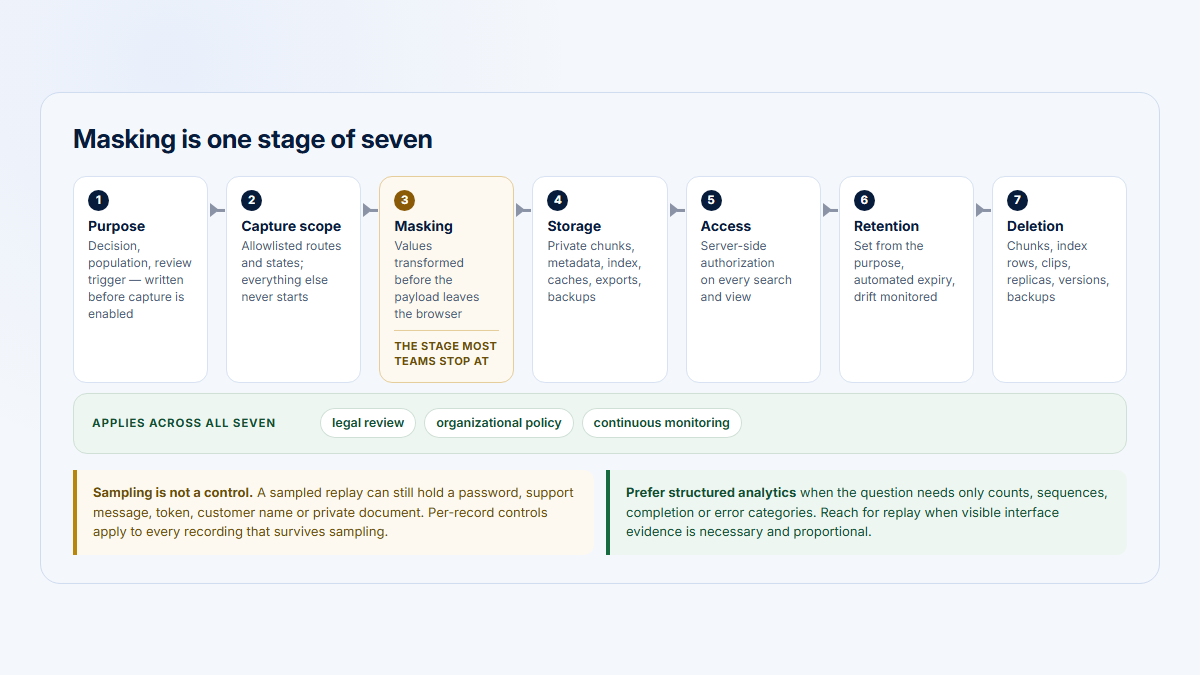
“Cookieless,” “privacy-friendly,” and “self-hosted” describe different properties. None removes the need to decide what is collected, why, for how long, who can access it, and whether local law or contracts require consent.
Hosted options
- PostHog Cloud removes most platform operations but can capture detailed product behavior.
- Matomo Cloud combines hosted operations with a broad web-analytics feature set.
- Plausible hosted minimizes product scope and maintenance.
- Regional, contractual, retention, and access controls still require review.
Self-hosted options
- Matomo has the most mature Community and commercial On-Premise model.
- Plausible Community Edition is open source but not identical to hosted plans.
- PostHog documents its OSS path as a hobby deployment with limitations.
- Your team owns patching, backups, scale, monitoring, incident response, and deletion.
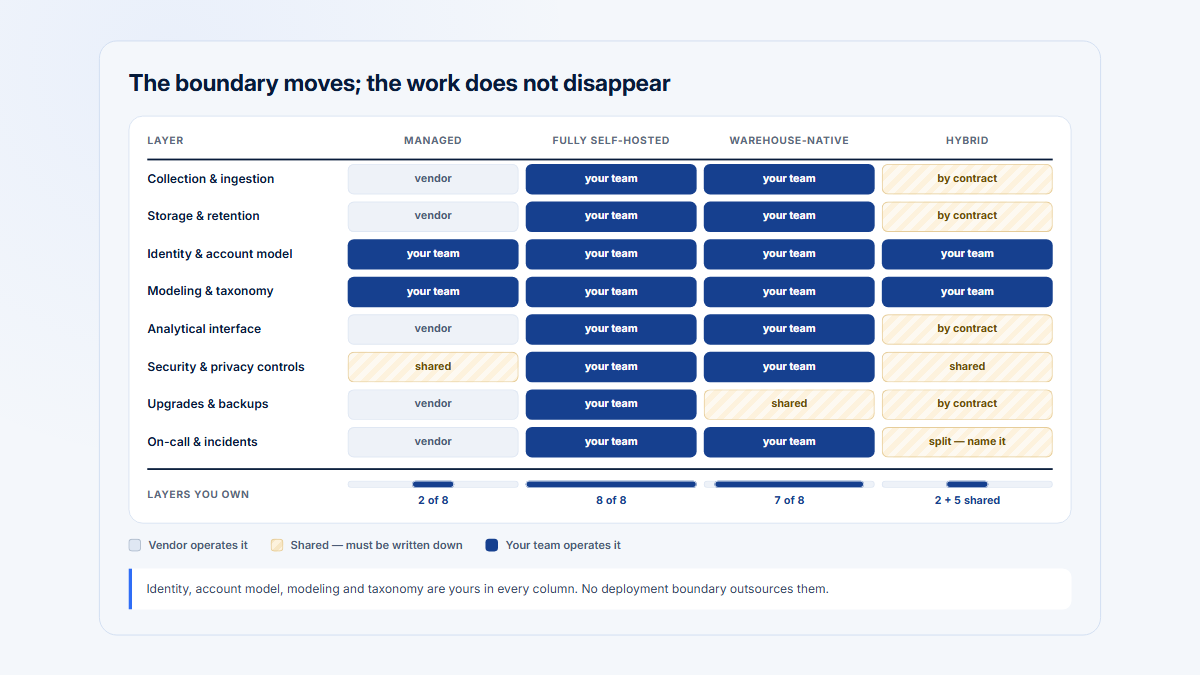
Self-hosting moves operations, not responsibility
Transfers to you when self-hosted
Yours in every model
What self-hosting does not do
Deployment control changes who operates the system. It does not automatically make a collection design private or compliant — that is decided by what you choose to collect.
Behavioral and website capabilities
| Capability | PostHog | Matomo | Plausible |
|---|---|---|---|
| Product funnels | Native and flexible | Premium/Cloud funnel module | Hosted-plan funnel analysis |
| Retention | Native | Cohorts on applicable plans | Not a native retention tool |
| Replay | Native with engineering context | Cloud or commercial module | None |
| Experiments | Native flags and experiments | A/B Testing commercial module | Measure externally assigned outcomes only |
| Traffic and referrers | Possible but secondary | Deep | Core and concise |
| Ecommerce | Custom event model | Deep native web/ecommerce reporting | Revenue tracking on applicable hosted plans |
| Raw export/API | APIs, warehouse, and pipelines by product | APIs, database access On-Premise, and integrations | Stats/Events APIs by plan; scheduled raw export on Enterprise |
Plausible's smaller surface is useful when teams want fewer collection and interpretation decisions. Matomo's depth is useful when website analytics must serve many stakeholders. PostHog's breadth is useful when product events should connect to replay and delivery workflows. None is automatically easier once the data model, consent, and operational burden are included.
Pricing and rating snapshot
Separate usage meters
PostHog Cloud
Free allowances by product
- 1 million monthly analytics events
- 5,000 web and 2,500 mobile replay recordings
- Initial paid analytics and adjacent-product rates vary by meter
Hits or self-hosted operations
Matomo
Cloud from about $26/month annually
- Cited Cloud tier: 50,000 monthly hits
- Free On-Premise Community core
- Commercial On-Premise modules and support cost extra
Page views plus custom events
Plausible hosted
Starter from $9/month annually
- Cited tier: 10,000 monthly page views, one site
- Growth and Business add sites, seats, and advanced reports
- Community Edition has no hosted subscription invoice
One PostHog event is not equivalent to one Matomo hit or one Plausible page view. Project the same real workload, then add replay, premium modules, retention, support, infrastructure, consent work, and staff time.
Prices, G2 ratings, and review counts verified August 4, 2026. Plausible's four-review sample is too small for a general market conclusion.
Which should you choose?
- Choose PostHog for authenticated product behavior, replay, experimentation, flags, and engineering context.
- Choose Matomo for broad web analytics, ecommerce, visitor histories, and a mature supported On-Premise option.
- Choose Plausible for a compact public-site dashboard where simplicity and aggregate measurement are requirements.
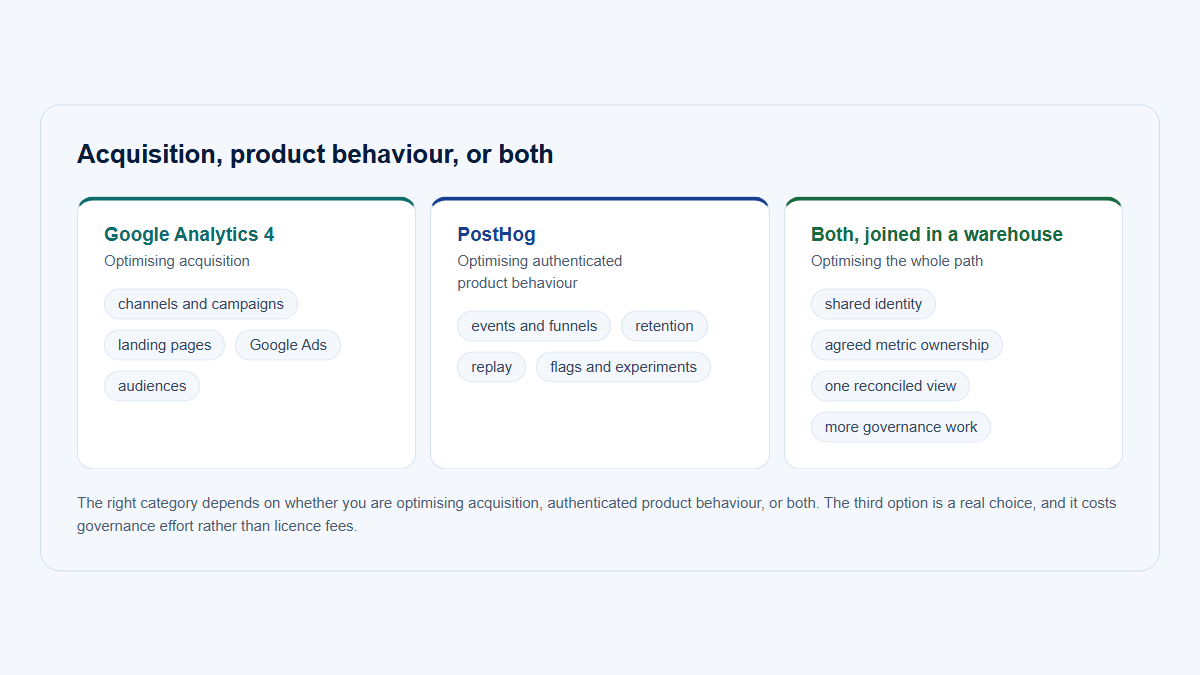
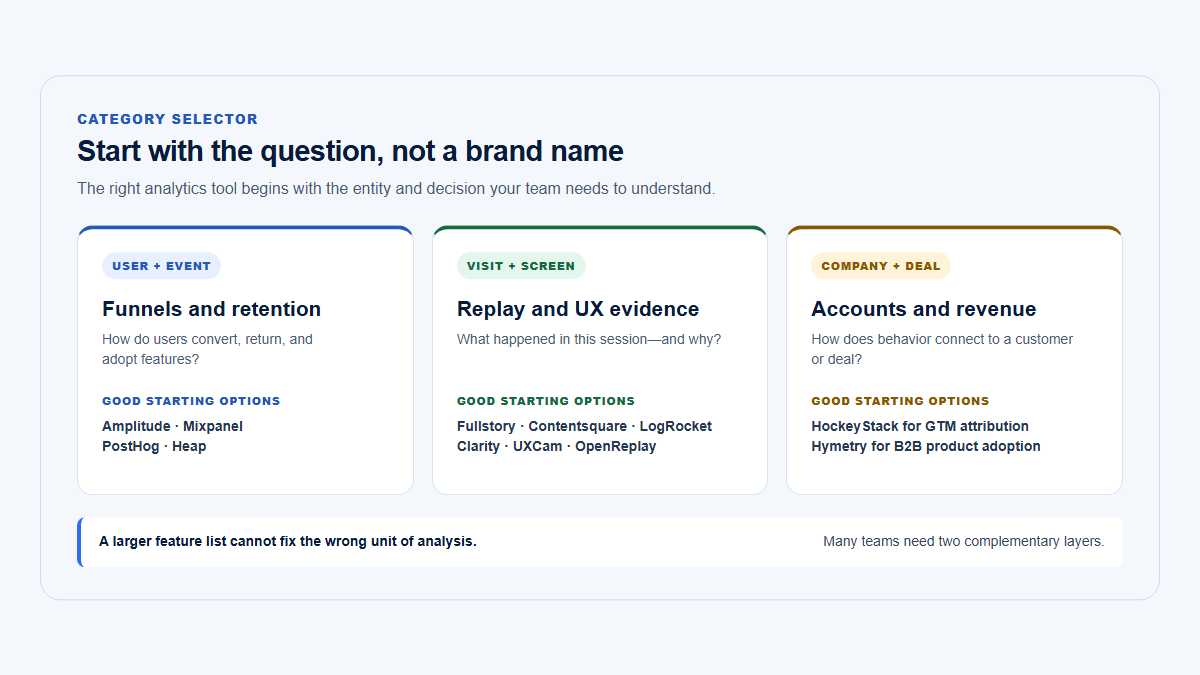
- Use separate tools when marketing acquisition and product adoption need different identities, reports, owners, and retention rules.
Test the finalist with one real migration, one consent state, one custom conversion, one export, and one month of expected volume. For self-hosting, also restore a backup, complete an upgrade, and document on-call ownership before treating “free software” as low cost.
Where Hymetry fits
| Decision | Consider Hymetry | Choose the compared platforms | Hymetry limitations |
|---|---|---|---|
| Primary job | B2B company adoption and user participation | Engineering analytics, full web analytics, or a simple public-site dashboard | Narrower analytical scope |
| Evidence | Companies, Users, grouped areas, and Visits | Events and experiments, visitor histories, or aggregate traffic | Smaller ecosystem and fewer integrations |
| Best question | Which customer accounts adopted a workflow, and who contributes? | How does a product, website, or campaign perform? | Not a replacement for flags, deep web reports, or minimalist site analytics |
Frequently asked questions
Is PostHog an alternative to Matomo?
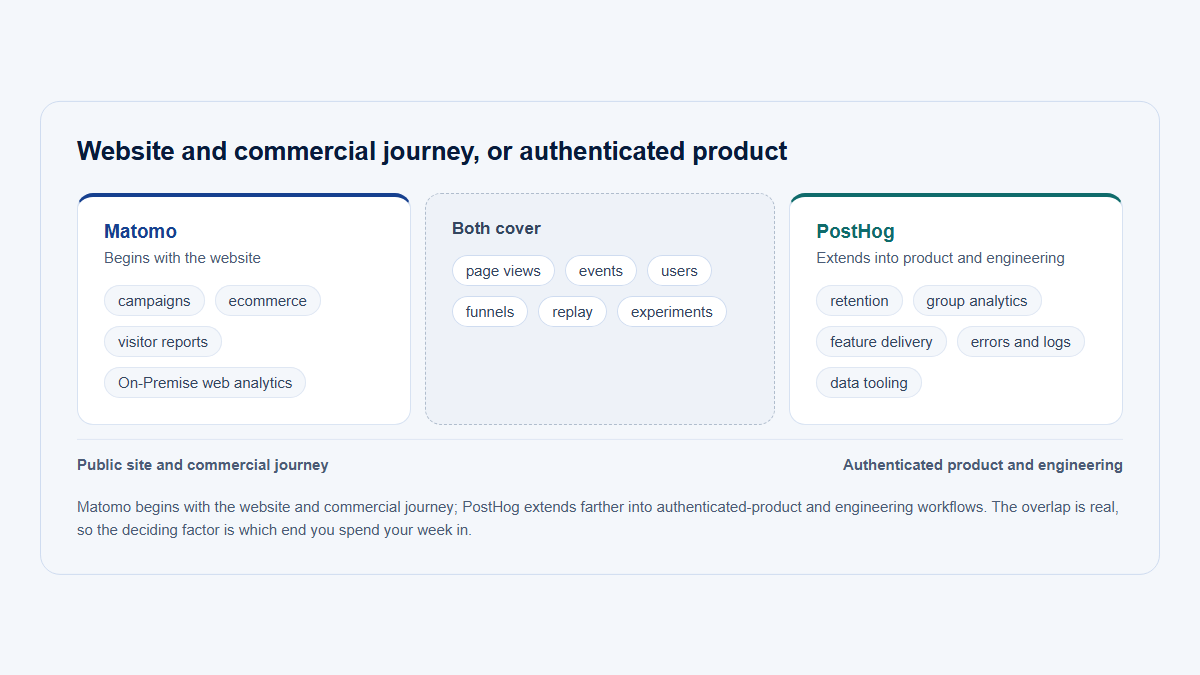
Yes for some event analysis, but their centers differ. PostHog is built around product behavior and engineering workflows; Matomo is built around web, acquisition, visitor, content, and ecommerce analytics.
Is Matomo better than Plausible?
Matomo is better when depth, visitor histories, ecommerce, replay, or supported On-Premise capabilities matter. Plausible is better when a small aggregate dashboard and low product complexity are the goals.
Which is easiest to use?
Plausible has the smallest analytical surface. Ease still depends on tracking design and governance; Matomo and PostHog expose more concepts because they solve broader jobs.
Which can be self-hosted?
All three have an open-source path, but they are not equivalent. Matomo has the most mature commercial On-Premise model; Plausible has Community Edition; PostHog describes its OSS path as a limited hobby deployment.
Does self-hosting guarantee privacy?
No. It changes infrastructure control. Collection, consent, lawful basis, masking, access, retention, security, and deletion still require deliberate design and legal review where appropriate.
Should a SaaS team use two tools?
Often. Plausible or Matomo can own public-site acquisition while PostHog owns authenticated product behavior. Document the identity boundary and which system owns each KPI.
Sources
Primary documentation, code repositories, pricing pages, and review listings were checked on August 4, 2026.
PostHog sources
Plausible sources
Methodology and disclosure
The recommendation weighs category fit, identity, product and web analysis, replay, experimentation, hosting, privacy responsibility, and total operating cost. The sponsored privacy video is presented with its disclosure and is not legal advice. Hymetry is the publisher's product; no compared vendor paid for inclusion and no affiliate links are used.
Additional preserved sources and related reading
Plausible sources
- Plausible Analytics
- Plausible documentation: Introduction
- Plausible documentation: Ecommerce revenue tracking
- Plausible documentation: Events API
- Plausible documentation: Google analytics import
- Plausible documentation: Stats API
- Plausible Analytics
- Plausible Analytics
PostHog sources
- PostHog documentation: Google analytics
- PostHog documentation: Data import export
- PostHog documentation: Migrate
- PostHog documentation: Google analytics
- PostHog documentation: Data collection
- PostHog
measureu.com sources
Matomo sources
- Matomo documentation: Faq 156
- Matomo documentation: How does ip address anonymisation work in matomo
- Matomo documentation: Faq 102
- Matomo documentation: Consent managers
- Matomo documentation: Pricingforai