Key differences
| Criterion | Amplitude | Mixpanel | Heap by Contentsquare |
|---|---|---|---|
| Center of gravity | Broad governed product analytics and product-building suite | Focused self-service semantic event analysis | Autocapture-first discovery and retrospective definition |
| Collection | Planned events plus supported autocapture | Event-first, with web autocapture | Broad UI capture, virtual definitions, and server events for critical outcomes |
| B2B accounts | Accounts expanded package on Growth and Enterprise; up to five group types | Group Analytics add-on on Growth and Enterprise | Account-Based Analytics on Pro and Premier |
| Replay | Native; allowance and retention depend on plan or package | Native; base allowances plus Enterprise retention options | Experience Analytics add-on on Pro and Premier |
| Experiments and flags | Native feature and web experimentation plus flags | Separate Enterprise add-ons | Analysis and integrations; no verified native flag delivery |
| Guides and surveys | Native, with plan limits | No current native product listed | Analytical “Guides” are not in-app tours; use integrations |
| Warehouse posture | Imports and exports; warehouse-native mode is legacy | Inbound Warehouse Connector and outbound Data Pipelines on qualifying packages | Heap Connect and integrations by plan or add-on |
| Best default | Platform breadth and governance | PM and analyst self-service | Historical flexibility after broad capture |
Not a universal leaderboard: the products overlap, but their operating models create different implementation, privacy, and maintenance costs.
Decision by scenario
| Buyer or situation | Start with | Why | Verify |
|---|---|---|---|
| Product operations and governance | Amplitude | Broad suite, planning, cohorts, and adjacent activation | Event volume, account, replay, and package boundaries |
| PM and analyst self-service | Mixpanel | Focused funnels, retention, and approachable exploration | Groups, experiments, flags, replay, and pipelines |
| Unknown historical UI questions | Heap | Autocapture and retrospective virtual-event definition | Masking, volume, history, replay, accounts, and Connect |
| One governed warehouse truth | Another category or complementary BI | Warehouse models and SQL may be the operating center | Whether teams still need low-latency self-service behavior |
| Frontend debugging | Replay or observability category | Console, network, errors, traces, and releases may matter more | Connection back to product and account impact |
| B2B account adoption with visit evidence | Complementary account-centric layer | Company breadth, momentum, and sessions become first-class | Integration, identity, privacy, and authoritative outcomes |
Instrumentation, history, and governance
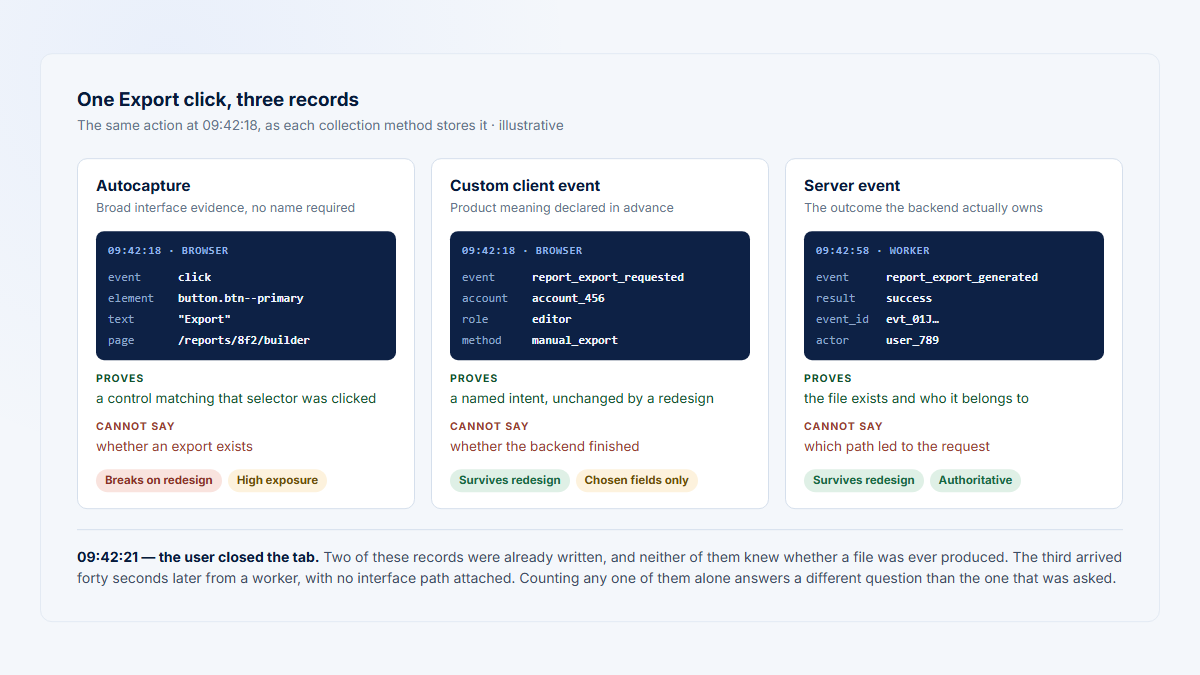
All three answer event-based questions; the central difference is when a raw interaction becomes a governed business concept. Mixpanel sits toward intentional instrumentation, Amplitude offers a meaningful hybrid, and Heap sits furthest toward collecting supported interactions first and defining useful events later.
Autocapture can preserve evidence for questions nobody anticipated, but it cannot reconstruct data never received, restore history beyond retention, infer a server outcome reliably from a click, or add an account key that was absent from old events.
- Use server-confirmed semantic events for outcomes such as
report_saved. - Use client evidence for paths, friction, and discovery.
- Apply the trade-offs in the guides to choosing autocapture or custom events and building a product analytics instrumentation plan.
Three collection strategies along one axis
Mixpanel
Toward intentional semantic instrumentation
Amplitude
A hybrid centre
Heap
Toward broad autocapture
A qualitative spectrum, not a ranking. All three eventually require the same artefact — a written definition of what counts as a meaningful action — and differ in when you are forced to produce it.
Identity and account rules
Amplitude group-property changes are not retroactive. Mixpanel cannot invent a missing group key for historical events. Heap account analysis still needs eligible packaging and deliberate configuration. Define stable user_id and account_id rules, anonymous-to-known transitions, membership changes, test accounts, internal users, and cross-device behavior before evaluating charts.
Governance risks
Semantic plans need contract tests and change review. Autocapture needs masking, selector, volume, and UI-change review. Hybrid implementations need both plus rules that prevent the same behavior being counted twice. Minimize sensitive data before collection rather than expecting a dashboard control to repair an overbroad payload.
Analytics, B2B accounts, and replay
Amplitude combines deep funnels, lifecycle analysis, cohorts, paths, and connections into its broader suite. Mixpanel is especially approachable for everyday funnels, retention, cohorts, flows, and breakdowns. Heap is strongest when analysts need to explore prior captured behavior and define supporting interactions retrospectively.
Model the account explicitly
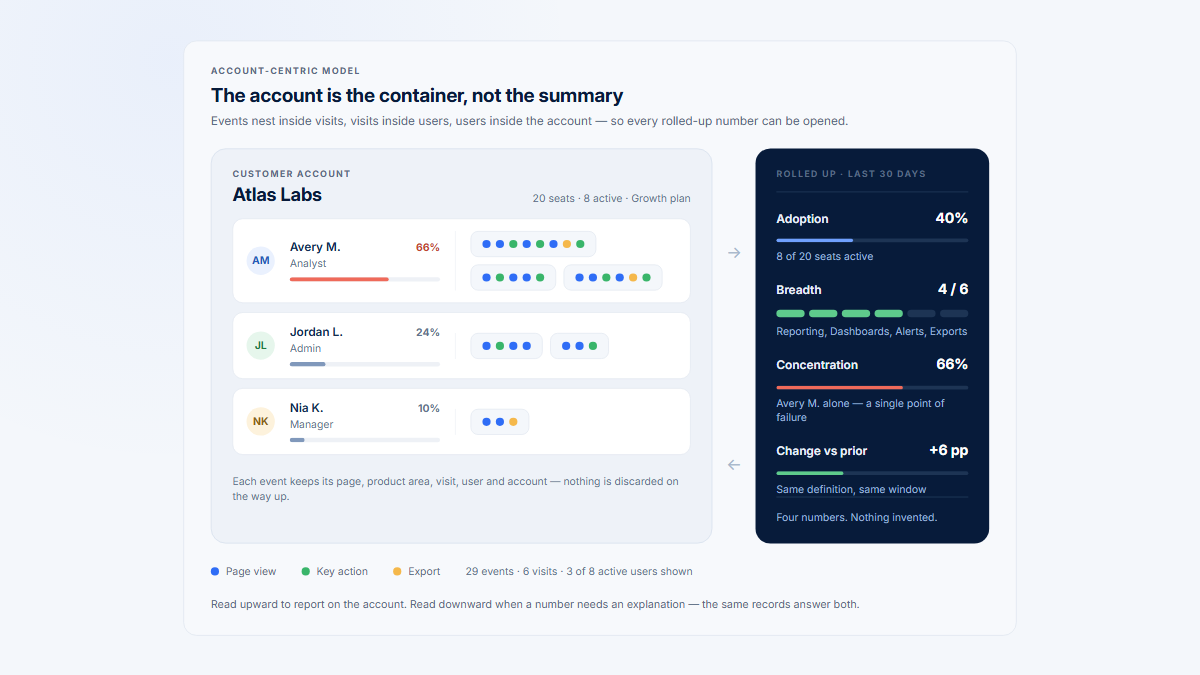
For B2B products, user-level analysis can hide that one power user represents an otherwise inactive account. None of the vendor labels replaces a canonical account model; measure breadth, depth, recency, role coverage, and sustained use.
- Amplitude: Accounts is available on Growth and Enterprise and supports up to five group types per project.
- Mixpanel: Group Analytics is a Growth and Enterprise add-on, and its group key must be present on relevant events.
- Heap: Account-Based Analytics is listed on Pro and Premier.
See account versus user adoption and measuring product usage by company.
Verify replay packaging and evidence
All three offer session replay, but allowances and packaging differ. A replay is reconstructed evidence subject to masking, sampling, SDK, browser, and retention constraints—not a literal screen recording.
- Amplitude: published monthly allowances rise by plan, with separately packaged expanded retention.
- Mixpanel: a base monthly allowance is supplemented by configurable retention through an Enterprise add-on.
- Heap: Experience Analytics is listed as an add-on for Pro and Premier, not an ongoing Free replay allowance.
The session replay versus product analytics guide explains when each evidence type helps.
Pricing and customer ratings
Amplitude
Free: 2 million events and 10,000 replay sessions per month, with unlimited seats. Plus includes the first 2 million monthly events free and then uses public event bands.
Model account analysis, replay retention, experimentation, guides, data share, and support separately.
Mixpanel
Free: 1 million events and 10,000 replay sessions per month, five saved reports, and unlimited seats. Growth lists $0.28 per 1,000 events after the first million, before discounts.
Model Groups, replay, experiments, flags, pipelines, and support separately.
Heap
Free: up to 10,000 monthly sessions and six months of history. Growth uses custom session-based pricing.
Heap’s public page was internally ambiguous about exact Pro project or environment counts, so this comparison does not assert one. Confirm sessions, history, Experience Analytics, Connect, and environments in writing.
Public allowances use different billing units and do not settle total cost. Include engineering, enablement, governance, privacy work, support, add-ons, and cleanup.
Amplitude Analytics
About 2,960 reviews
Often valued for breadth and cohorts; watch learning curve, governance, packaging, and scale costs.
Mixpanel
About 1,370 reviews
Often valued for approachable self-service; watch cost growth, taxonomy discipline, and add-ons.
Heap
About 1,100 reviews
Often valued for autocapture and retroactive definition; watch volume, definition management, and plan complexity.
G2’s Product Analytics theme page was updated July 5, 2026. Review counts move continuously and direct product pages may challenge automated access, so counts are rounded.
Which should you choose?
- Choose Amplitude when a governed multi-team platform and native adjacent tools justify the broader operating surface.
- Choose Mixpanel when PMs and analysts need clear, fast self-service around a deliberately maintained event model.
- Choose Heap when recovering unplanned interface questions from retained capture matters more than minimizing collection breadth.
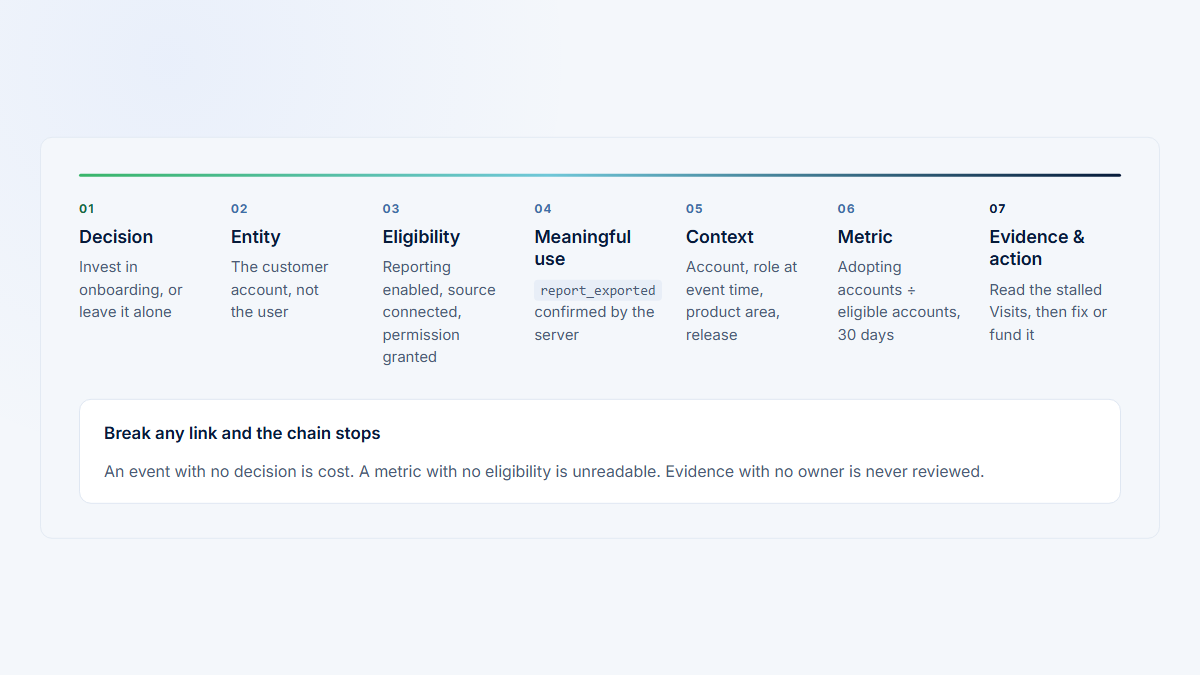
In a proof of concept, ask each system the same activation, conversion, retention, path, and account-participation questions. Record who can answer, how long it takes, which add-on is required, and whether the result survives identity and timezone checks. For a B2B reporting workflow, send a server-confirmed report_saved outcome with account_id; use client evidence only to investigate the path around it.
Migration and implementation checks
Start migration with core outcomes, identity, accounts, eligibility, cohort rules, history, destinations, dashboards, and regulatory constraints—not a literal translation of every old event. Establish masking and exclusions before broad capture, and preserve server truth for outcomes.
Run old and new systems in parallel long enough to compare event counts, identities, account membership, conversion windows, timezone behavior, internal exclusions, late events, and deletion. Investigate unexplained large differences before changing executive metrics.
Where Hymetry fits
Hymetry is not a general replacement for Amplitude, Mixpanel, or Heap. Its narrower role is account-centric B2B product evidence: adoption and friction by company, participation by user, behavior by product page, and the visits behind a signal.
That can complement a broader analytics stack when teams need to move from “usage fell” to “which accounts changed, which people participated, and what happened in the relevant visits?” It still requires honest identity rules, privacy controls, and authoritative server outcomes. No customer logos, performance benchmarks, or results are implied.
Frequently asked questions
Which is best: Amplitude, Mixpanel, or Heap?
There is no universal winner. Amplitude is the strongest default for platform breadth and governance, Mixpanel for focused self-service semantic analysis, and Heap for autocapture-first retrospective definition. Run the same real workflow in each product.
Does autocapture remove the need for custom events?
No. Autocapture preserves interface evidence, but critical outcomes such as a saved report or completed payment should normally be confirmed by the backend. A hybrid plan is usually more durable.
Can Heap answer any historical question?
No. Heap can retroactively define events only from supported data that was captured and retained. It cannot recover a missing interaction, account key, server result, or expired period.
Do all three support B2B account analytics?
Yes, on specific packages: Amplitude Accounts on Growth and Enterprise, Mixpanel Group Analytics as a Growth and Enterprise add-on, and Heap Account-Based Analytics on Pro and Premier. Identity and account modeling remain your responsibility.
Do all three include session replay?
All three offer replay, but allowances and packaging differ. Amplitude and Mixpanel publish base monthly allowances. Heap lists Experience Analytics as an add-on on Pro and Premier rather than an ongoing Free allowance.
Which has native experimentation?
Amplitude has the broadest native experimentation and feature-flag story. Mixpanel offers Experiments and Feature Flags as separate Enterprise add-ons. Heap analyzes experiment behavior and integrates with delivery tools, but this review did not verify comparable native flag delivery.
Sources
Disclosure: Hymetry publishes this comparison and is mentioned only where its narrower account-centric B2B model is relevant. Product capabilities, prices, ratings, packaging, ownership, and videos are verified against linked sources and may change after publication.
Methodology: We researched public product, documentation, legal, ratings, and video pages available on . We compared collection, identity, accounts, analysis, replay, experiments, data movement, privacy, implementation, pricing, and the same B2B reporting workflow. Qualitative judgments describe fit rather than numeric scores.
Evidence limits
Evidence limits: G2 pages can block automated access, so review counts are rounded. Heap’s pricing page presented inconsistent Pro project and environment counts, so no exact count is asserted. Availability can depend on plan, add-on, region, contract date, or early-access status.
Amplitude official sources
- Amplitude pricing and package comparison
- Amplitude limits and quotas
- Amplitude autocapture documentation
- Amplitude account-level reporting
- Amplitude Session Replay overview
- Amplitude Feature Experiment overview
- Amplitude Guides and Surveys
- Amplitude legacy warehouse-native status
- Amplitude import and export options
- Amplitude client-side versus server-side collection
Mixpanel official sources
Heap, ratings, and video sources
- Heap pricing and plan comparison
- Heap and Contentsquare relationship
- Heap’s approach to event tracking
- Heap server-side Track API
- Heap Connect overview
- Contentsquare Product Analytics service schedule
- G2 Product Analytics theme ratings
- Heap reviews on G2
- Vision Labs product analytics tools review
- CX Circle behavioral backbone session