Key differences
| Criterion | PostHog | Google Analytics 4 | Analytics 360 |
|---|---|---|---|
| Center of gravity | Authenticated product behavior and engineering | Website/app acquisition, marketing, and ecommerce | Enterprise Google Analytics operations |
| Core model | Events, persons, sessions, and optional groups | Events, users, sessions, sources, audiences, and properties | The same GA4 model with higher limits and governance |
| Product analytics | Strong native funnels, retention, paths, cohorts, replay, and product workflows | Possible through events and Explorations, but not the default product orientation | GA4 analysis at greater enterprise scale; not a different methodology |
| B2B accounts | Paid group-analytics add-on; up to five group types per project | Custom properties and warehouse modeling, not a first-class account object | Higher custom limits, but still no native customer-company model |
| Replay, flags, surveys | Native replay, feature flags, experiments, and surveys | No native replay, general flag delivery, experiment delivery, or surveys | Same category gap as GA4 |
| Acquisition and ecommerce | Available, but less specialized | Core strength with recommended ecommerce events and Google Ads workflows | GA4 capabilities with enterprise scale and governance |
| Data export | Warehouse sources, destinations, and batch exports | BigQuery export subject to Standard limits | Higher-scale BigQuery options, including eligible Fresh Daily export |
| Price model | Modular usage billing after free allowances | No Standard analytics license fee | Custom enterprise contract with base allowance and event tiers |
Three different operational priorities
PostHog
Authenticated product behaviour and engineering
Google Analytics 4
Acquisition and public-site analytics
Analytics 360
GA4 extended for enterprise scale
The products overlap on event collection and behavioural reporting but begin from different operational priorities. Analytics 360 shares GA4’s colour here because it is not a third category — it is GA4 with enterprise scale and governance.
Decision by scenario
| Scenario | Best starting point | Validate before purchase |
|---|---|---|
| Authenticated SaaS product analysis | PostHog | Identity, group add-on, event volume, replay sampling, and governance |
| Public-site acquisition and campaigns | GA4 | Consent, channel definitions, tagging, attribution, and reporting needs |
| Enterprise Google limits and governed properties | Analytics 360 | Contract, service levels, subproperties, roll-ups, and BigQuery architecture |
| Product replay, flags, and experiments | PostHog | SDK support, privacy, exposure design, and separate usage meters |
| Large-scale ecommerce and Google Ads | GA4 or Analytics 360 | Whether Standard limits or enterprise requirements justify 360 |
| Acquisition plus product adoption | GA4 plus PostHog | Shared business events, stable IDs, warehouse joins, and consent boundaries |
Product and marketing data models
All three use events, but event-based does not mean equivalent. PostHog organizes work around events, persons, sessions, and optional groups. It is designed for questions such as which identified users adopted a workflow, where a funnel failed, what a cohort retained, and what happened in the supporting session.
GA4 represents pages, screens, purchases, and custom interactions as events with parameters, then organizes them through users, sessions, traffic sources, audiences, dimensions, metrics, and properties. That model is especially useful from source and campaign through conversion. Analytics 360 keeps the same model; its value is enterprise scale and control, not a new product-analytics philosophy.
Model B2B accounts explicitly
For B2B accounts, PostHog's paid group analytics can model companies, workspaces, or organizations in trends, funnels, retention, flags, and experiments. GA4 and 360 can carry account identifiers as approved custom data and join them in BigQuery, but they do not become a first-class customer-company product by doing so. Review the B2B product-analytics instrumentation plan before choosing a schema.
Replay, experiments, and account workflows
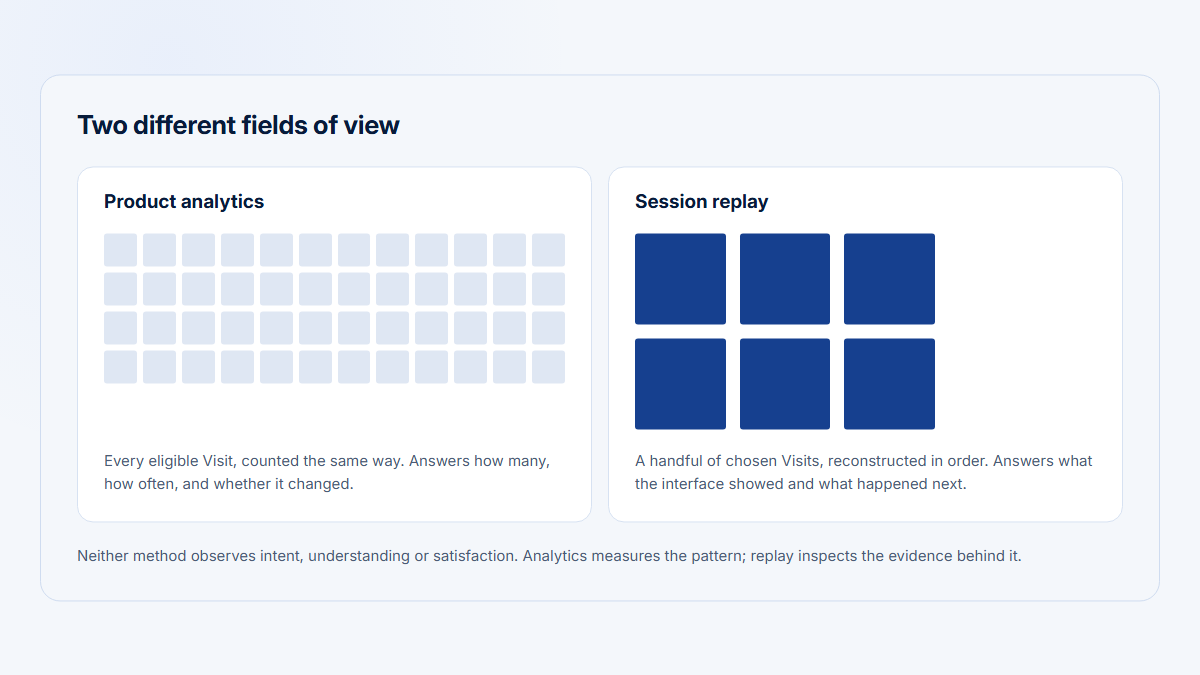
PostHog's native replay is the largest category difference. It can connect aggregate behavior to web or mobile recordings, while GA4 and 360 require a companion replay tool. Replay remains evidence, not proof of motivation: use aggregate analysis to select sessions, inspect multiple examples, and return to quantitative validation. The session replay versus product analytics guide explains that loop.
PostHog also connects feature-flag delivery to experiments and supports surveys. GA4 can analyze exposure and outcomes sent by another system, but it is not a general native flag or experiment-delivery platform. Google Optimize and Optimize 360 were sunset September 30, 2023; a separate Firebase A/B Testing workflow should not be confused with GA4 itself providing broad flag infrastructure.
Acquisition, warehouse, and enterprise governance
GA4 is the stronger default for acquisition, recommended ecommerce events, attribution, audiences, and Google Ads relationships. PostHog can measure public-site behavior, but teams should not assume it reproduces every mature marketing or ecommerce workflow. Analytics 360 becomes relevant when the same Google model needs higher limits, subproperties, roll-up properties, eligible higher-scale BigQuery export, support, and contractual service levels.
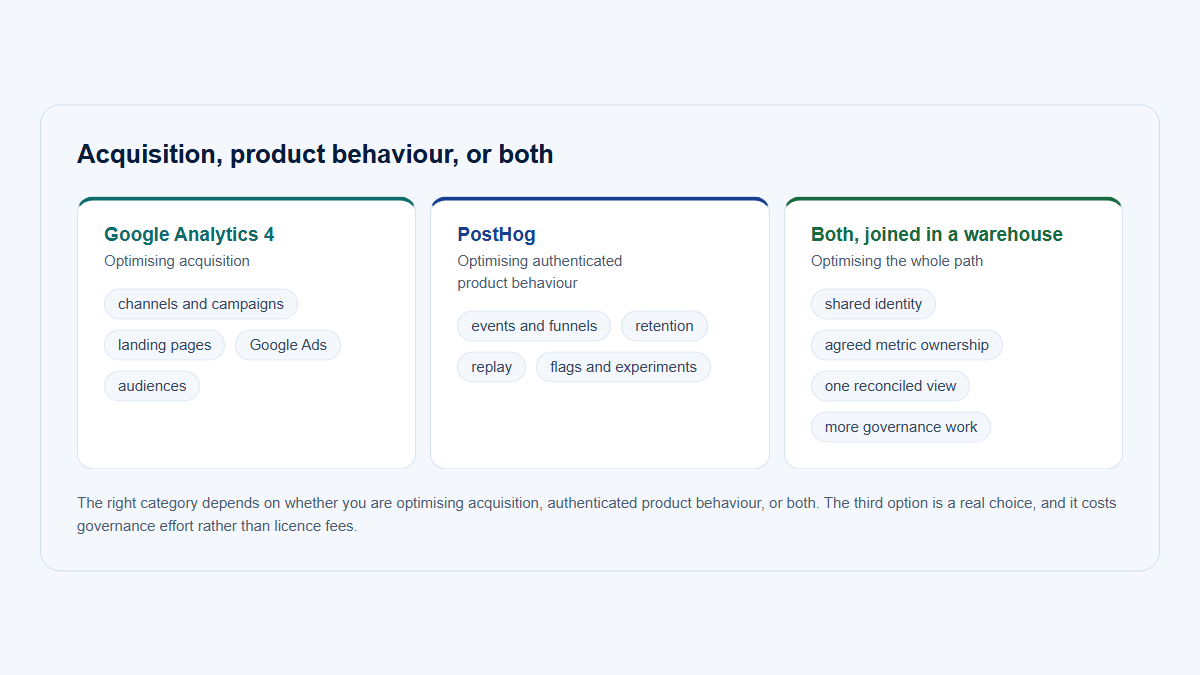
For a combined SaaS stack, put GA4 on the public acquisition journey and PostHog in the authenticated product. Align a small set of business events such as sign-up completion, workspace creation, core-value completion, and subscription start. Do not duplicate every automatic event. Maintain a canonical identity dictionary and join approved data through a governed warehouse or identity layer.
Two owners, joined by governed identity
Marketing acquisition
The join
Authenticated product
GA4 or Analytics 360 can own acquisition measurement while PostHog owns authenticated-product investigation, joined through governed identity and warehouse logic. That join is something you build.
Pricing and customer ratings
PostHog
Monthly free allowances included 1 million analytics events, 5,000 web replays, 2,500 mobile replays, and 1 million flag requests. Public rates varied by product and event type.
Identified product analytics began around $0.000248 per event; web replay $0.005 per recording; mobile replay $0.01; flags $0.0001 per request; surveys $0.10 per response. Group analytics was a paid add-on.
Google Analytics 4
Standard Google Analytics has no analytics license fee.
Budget for implementation, consent tooling, server-side tagging, BigQuery, BI, replay, experiments, specialist support, and recurring QA where required.
Analytics 360
Custom pricing. Google described a fixed base fee covering the first 25 million monthly events, followed by tiered variable fees above that allowance.
Rates can vary by market and contract. Include partner services, governance, BigQuery, data engineering, migration, and training.
Pricing was verified August 4, 2026. PostHog's products use distinct meters, GA4 can carry substantial operating costs despite no license fee, and Analytics 360 requires a current quote.
PostHog
Approximately 1,053 reviews
Verified August 4, 2026.
Google Analytics
Approximately 6,860 reviews
Verified August 4, 2026.
Google Analytics 360
Approximately 599 reviews
Verified August 4, 2026.
G2 was used as one common source; scores were not averaged with other sites. Rounded ratings and changing review counts do not prove product fit, support quality, current pricing, or implementation effort.
Which should you choose?
- Choose PostHog for an authenticated application where product behavior, replay, experiments, flags, and engineering action belong together.
- Choose GA4 for public-site acquisition, campaigns, ecommerce, audiences, attribution, and Google advertising workflows.
- Choose Analytics 360 only when GA4 is already the right category and enterprise limits, governance, support, and service levels justify it.
- Use GA4 and PostHog together when acquisition and product adoption are both first-class jobs.
Start from the decision your team must make
GA4
If the decision is about acquisition
Analytics 360
If enterprise Google requirements decide it
PostHog
If it is about authenticated product behaviour
A combined stack — if both acquisition and product adoption matter
Start with the decision the team must make, then choose the product category that supports it. Two colours, because Analytics 360 is a tier of the Google family rather than a separate vendor; the combined stack is neutral because it is not a product at all. Its cost is governance effort rather than licences.
Where Hymetry fits
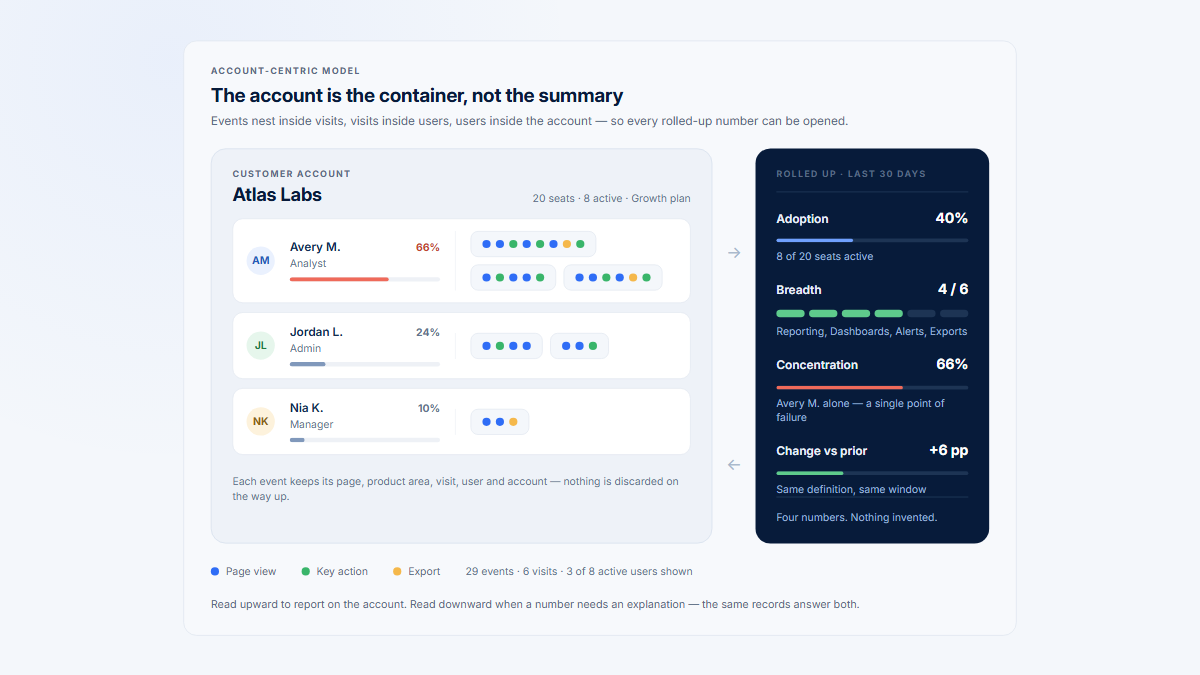
Hymetry is account-centric product intelligence for B2B SaaS. It connects grouped product pages and areas with Companies, Users, account adoption, user distribution, and Visits. That starting point is useful when a team asks which customer companies adopted a workflow, whether use is broad or champion-dependent, and which sessions explain the signal.
It does not replace GA4 or Analytics 360 for acquisition and advertising, PostHog for a broad developer platform and feature delivery, or a mature warehouse and enterprise stack. It is narrower and has a newer, smaller ecosystem.
Frequently asked questions
Can PostHog replace Google Analytics?
It can when product behavior, replay, funnels, retention, experiments, flags, and surveys matter more than sophisticated acquisition, ecommerce, audiences, and Google Ads workflows. Many SaaS teams retain GA4 for acquisition.
Should a SaaS company use PostHog and GA4 together?
Often. Put GA4 on the public acquisition journey, PostHog in the authenticated product, and connect a small set of business events through stable, consented identities and governed warehouse logic.
What is the difference between GA4 and Analytics 360?
Analytics 360 uses GA4's underlying event model but adds higher limits, longer eligible retention, higher-scale export, governed property structures, service levels, support, and enterprise contracting.
Is Analytics 360 better for product analytics?
Not inherently. It increases scale and governance but does not add native replay, feature flags, broad experiment delivery, surveys, or a first-class customer-company model.
Does PostHog support B2B account analytics?
Yes, through its paid group-analytics add-on. Teams must still implement stable group IDs, membership, approved properties, and an account-adoption definition. Current documentation supported up to five group types per project.
Which product has session replay?
PostHog has native web and documented mobile replay. GA4 and Analytics 360 do not include native session replay and require a companion product.
Which is cheapest?
GA4 Standard has no analytics license fee and is usually cheapest for basic public-site analytics. PostHog can fit within free allowances but meters several products. Analytics 360 is a custom enterprise contract. Compare total operating cost.
Sources
Disclosure and methodology
Hymetry publishes this comparison and is mentioned only where its account-centric B2B product model is relevant. Product capabilities, prices, ratings, and videos are verified against linked sources and may change after publication.
The products were compared by category, event and identity model, public-site and authenticated-product analysis, B2B groups, funnels and retention, replay, flags and experiments, acquisition and ecommerce, export, deployment, governance, price, and review themes. No weighted numerical winner was calculated because the products begin from different priorities. Independent and vendor-authored sources were not used to override current primary documentation.
Pricing and legal boundaries
Pricing uses current official public pages. Analytics 360 remains Custom pricing because no reliable universal public contract price is available. PostHog rates retain their billing units and free allowances rather than being reduced to one misleading entry price. Privacy discussion compares technical controls and data flow, not jurisdiction-specific legal conclusions.
PostHog official sources
Google official sources
- Google Analytics overview
- Analytics 360 overview
- Analytics 360 property limits
- Analytics 360 billing
- Analytics 360 service-level agreement
- Analytics subproperties
- Analytics roll-up properties
- Fresh Daily BigQuery export
- GA4 BigQuery export
- GA4 ecommerce
- A/B testing tools with Google Analytics
- Google Optimize sunset
Ratings and video context
Additional references from the original article
- official User-ID documentation
- Funnels
- Retention
- Explorations
- Funnel exploration
- Path exploration
- Cohort exploration
- Google Analytics data retention
- BigQuery Export schema
- BigQuery export types and reporting differences
- Google consent mode
- Google Analytics privacy controls
- Surveys
- SDKs and libraries
- Firebase Analytics
- product usage by company
- account versus user adoption
- self-hosted product analytics