Key differences
| Criterion | Amplitude | Mixpanel | PostHog |
|---|---|---|---|
| Primary position | Broad analytics and product-intelligence suite | Focused self-service behavioral analytics | Engineering-oriented analytics and product tooling |
| Best fit | Mature product-data programs with governance needs | Product and growth teams prioritizing fast analysis | Technical teams that want analysis and shipping tools together |
| Account analytics | Accounts package for Growth and Enterprise | Paid Group Analytics add-on | Paid Group Analytics add-on; up to five group types per project |
| Collection | Web and supported mobile autocapture plus planned events | Web autocapture plus explicit events | Web autocapture by default; mobile varies by SDK and event type |
| Replay | Web and mobile; account-report replay limitations apply | Web and mobile replay linked with analytics | Web and mobile replay linked to events, errors, and logs |
| Experiments and flags | Native; limits and expanded packages vary | Native, currently Enterprise add-ons | Native and integrated; request-based pricing |
| Data infrastructure | Sources, destinations, exports; warehouse-native mode is legacy | Warehouse imports and paid Data Pipelines | Managed warehouse, external sources, SQL, destinations, exports |
| Deployment | No public self-hosted app | No public self-hosted app | Open-source self-hosting exists but is officially unsupported |
| Main limitation | Breadth and package complexity | Important advanced jobs require add-ons | Broad surface and many independent meters |
Decision by scenario
| Scenario | Start with | Why | Verify |
|---|---|---|---|
| Governed multi-team analytics | Amplitude | Depth, cohorts, account reporting, and connected activation | Package boundaries and implementation ownership |
| Fast PM and analyst exploration | Mixpanel | Concentrated, approachable reports | Add-ons and event-volume cost |
| Engineering-led product stack | PostHog | Flags, experiments, replay, errors, and data tools together | Operational scope and each billing meter |
| Dedicated onboarding | Another category | Guides and education are the primary job | Audience sync back to analytics |
| Replay-first debugging | Observability or replay specialist | Technical diagnosis matters more than aggregate analytics | Connection to users, accounts, and releases |
| B2B company adoption | Account-centric complement | Companies and visits are first-class evidence | Identity, privacy, and authoritative outcomes |
Analytics and data model
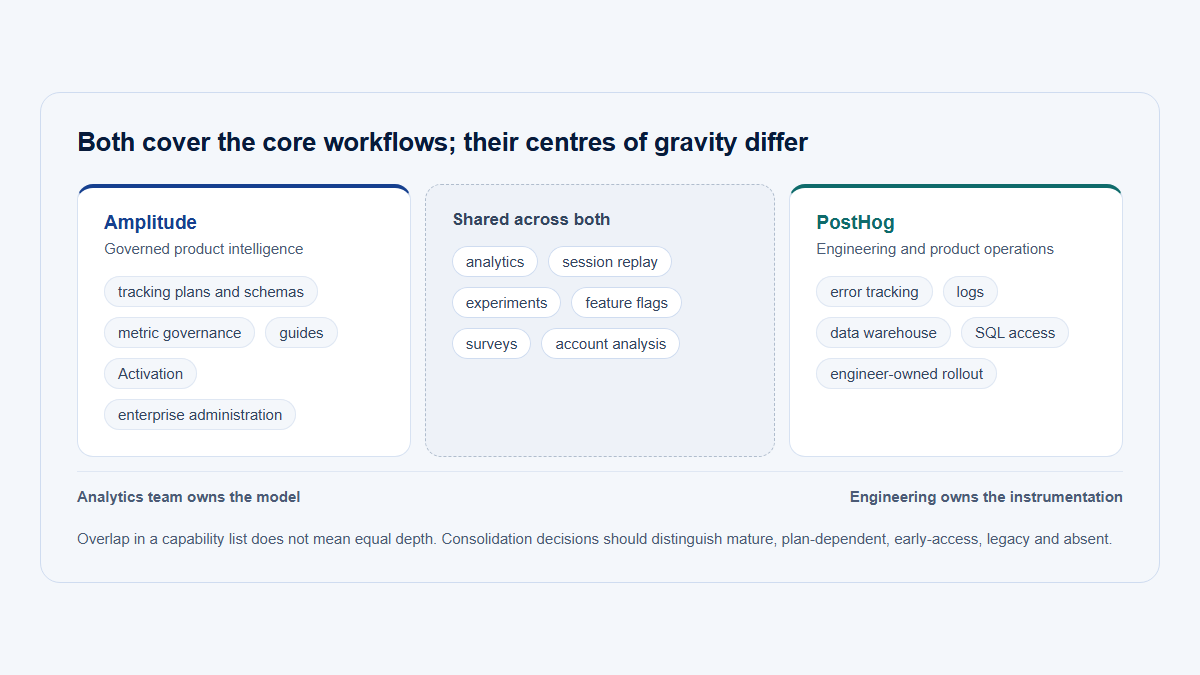
Amplitude is strongest when a mature organization needs deep segmentation, formulas, behavioral cohorts, lifecycle analysis, monitoring, and reusable governed metrics. Mixpanel makes funnels, retention, cohorts, and flows accessible to a wider product audience. PostHog combines standard product analytics with HogQL/SQL for technical analysis and connects cohorts across replay, flags, experiments, and surveys.
Model identity and accounts first
Identity and accounts remain implementation work. Adding a company property later does not automatically make historical events group-aware.
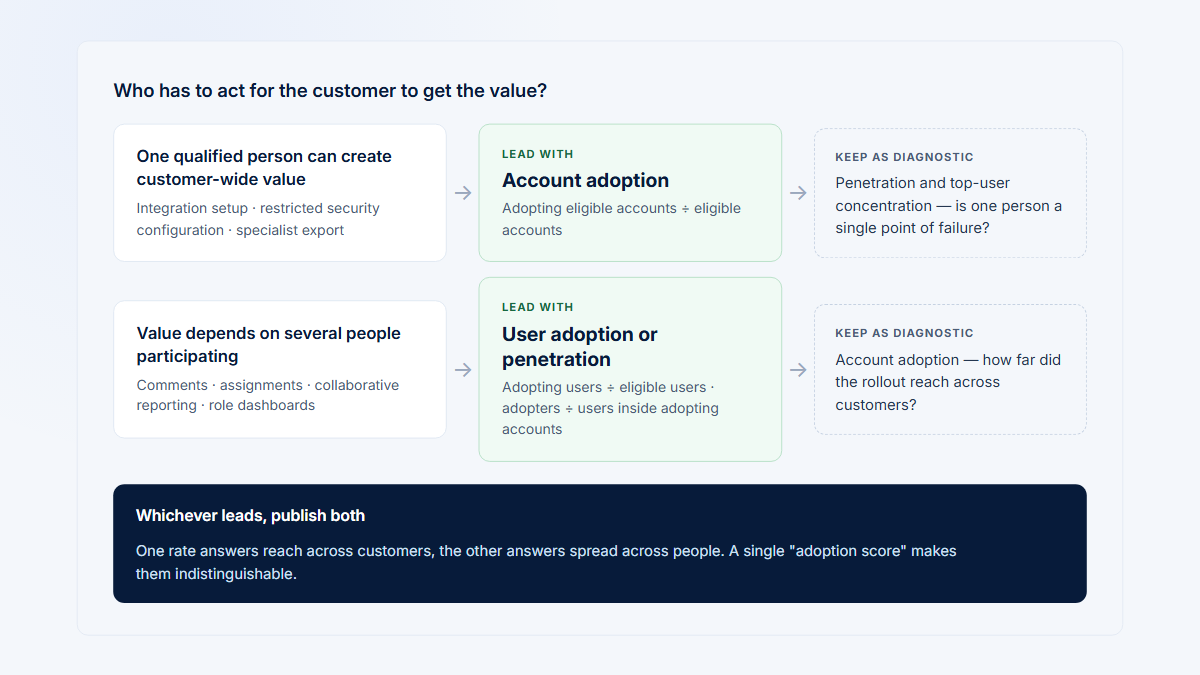
Amplitude Accounts and Mixpanel Group Analytics require relevant group context; Mixpanel explicitly says the feature cannot be applied retroactively without the necessary historical data work. PostHog distinguishes anonymous and identified events and uses paid Group Analytics for group-level questions. Define user_id, account_id, aliases, membership changes, and deletion behavior before judging any dashboard.
Balance semantic events and autocapture
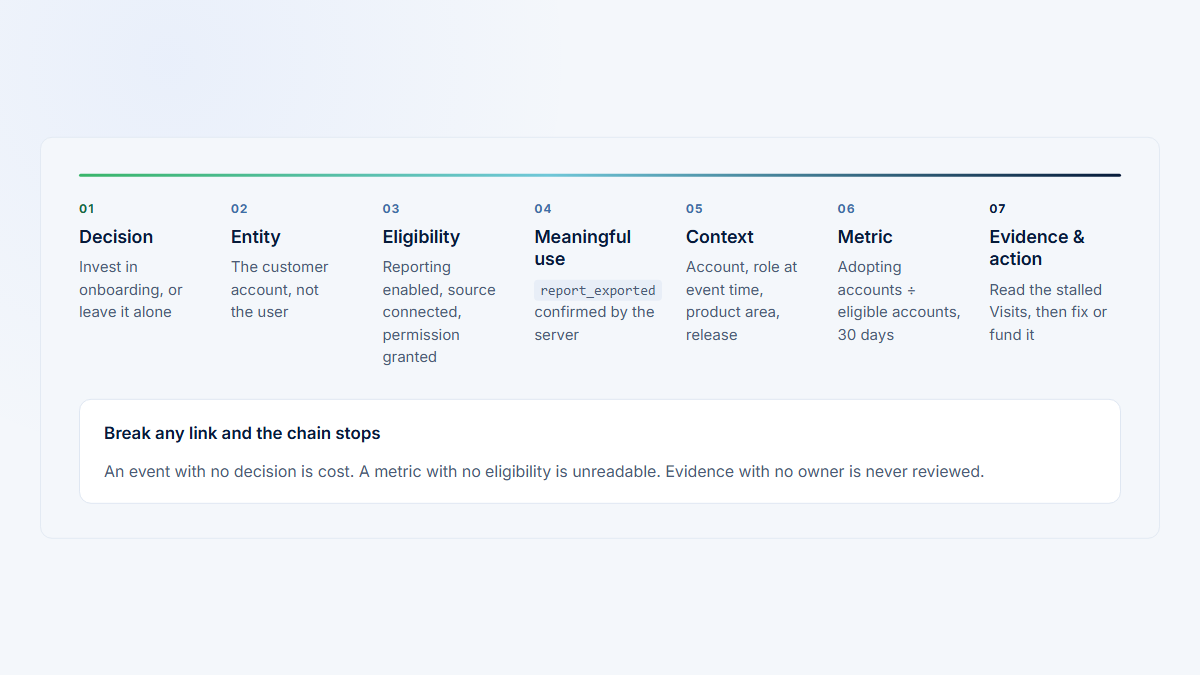
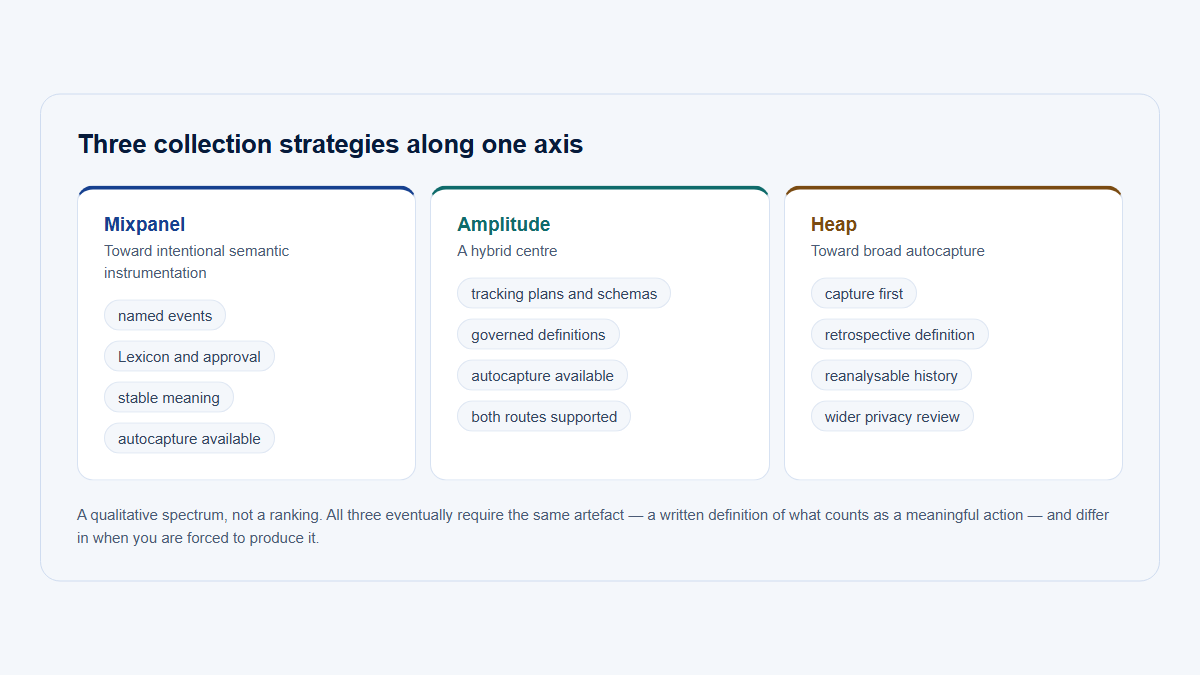
All three combine explicit events with some autocapture. Use client capture for exploratory paths and server-confirmed events for durable outcomes. Broad capture raises masking, exclusion, retention, and volume obligations; a semantic plan raises taxonomy and change-management obligations. The product analytics instrumentation plan and account versus user adoption guide provide implementation patterns.
Three product surfaces, same starting capability
Amplitude
Mixpanel
PostHog
Core product analytics
Broad and deep
Concentrated and deep
Broad and deep
Session replay
Available; retention extension is paid
Available; longer retention needs a plan and add-on
Core, web and mobile
Experiments and flags
Broad suite; advanced packages priced separately
Advanced reporting is Enterprise and priced separately
Core to the platform
Guides and surveys
Native to the platform family
Not native in reviewed documentation
Surveys native; guidance narrower
Error tracking and logs
Not part of the platform
Not part of the platform
Native; confirm maturity stage
Warehouse and SQL
Ingestion, exports, Activation package
Connectors, APIs, Data Pipelines
Warehouse and direct SQL
Governance and administration
Tracking plans, schemas, enterprise controls
Lexicon, approval, verified content
Lighter; more convention than enforcement
Availability does not mean identical depth or inclusion. Filled segments show documented emphasis, hatched means plan-dependent, add-on or early stage — confirm plan-specific qualifications before consolidating.
Replay, experiments, and data infrastructure
Replay and heatmaps
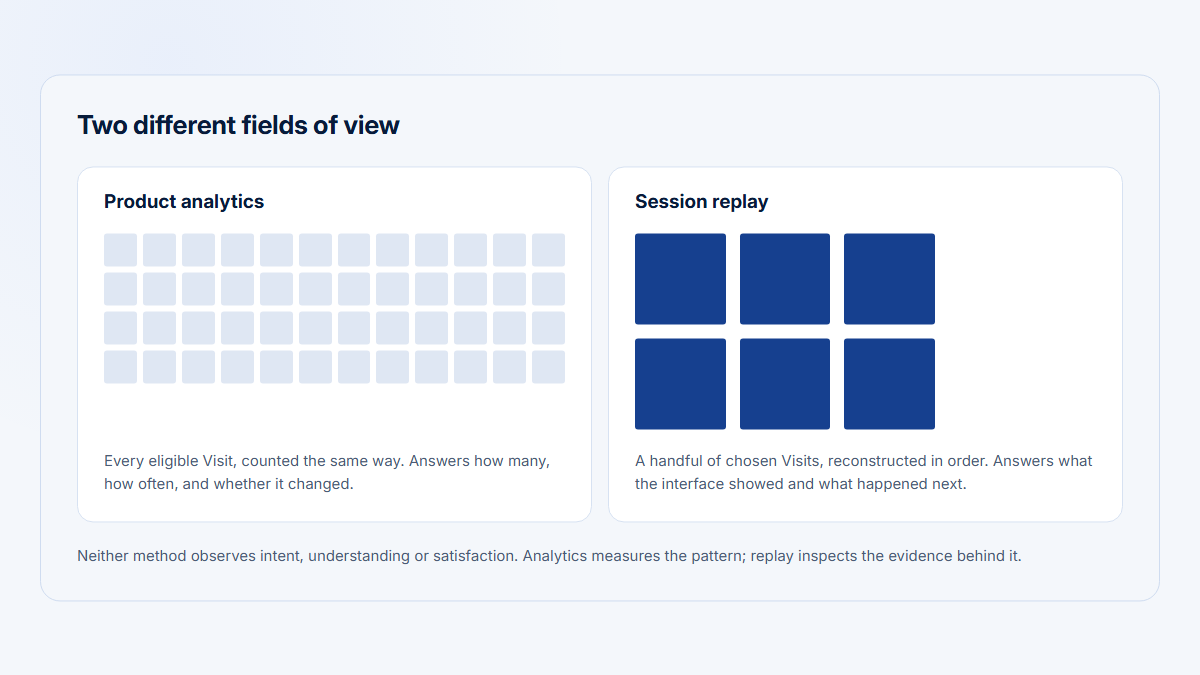
Amplitude offers web and mobile replay plus web heatmaps, with plan and replay entitlements; account-level reporting does not become an account-aggregated replay view. Mixpanel offers web and mobile replay, but mobile requires a client replay SDK. PostHog links replay to users, events, errors, logs, and workflows; its free tier included 5,000 web and 2,500 mobile recordings.
Experiments and product delivery
Amplitude provides native feature and web experimentation, flags, guides, and surveys with plan limits. Mixpanel’s Experiment reporting and Feature Flags were Enterprise add-ons, and no dedicated first-party guide or survey product was documented. PostHog tightly connects experiments, flags, surveys, and errors; experiments are billed with flag requests.
For data movement, separate inbound warehouse sync, outbound export, where queries run, schema control, backfills, latency, deletion, and cost. Amplitude’s older Snowflake warehouse-native mode is legacy and unavailable to new customers. Mixpanel synchronizes eligible warehouse data into the product and sells Data Pipelines separately. PostHog offers a managed warehouse, external sources, HogQL/SQL, destinations, and batch exports, each with its own allowance or rate.
PostHog’s open-source self-hosting path is officially unsupported. Treat infrastructure, upgrades, observability, backups, incident response, privacy, and security maintenance as customer costs—not as a free equivalent to managed service.
Pricing and customer ratings
Amplitude
Free: 2 million events and 10,000 monthly replays. Plus starts at $0 while under the free allowance; public tiered event pricing then applies.
The Plus card advertised scale to 70 million events while the annual base-tier table stopped at 20 million. Confirm the self-serve-to-quote boundary and expanded packages.
Mixpanel
Free: 1 million events and 10,000 monthly replays. Growth listed $0.28 per 1,000 events after the first million, before volume discounts.
Confirm Groups, Experiments, Flags, Metric Trees, and Data Pipelines as separately packaged capabilities.
PostHog
Free: 1 million analytics events, 5,000 web replays, 2,500 mobile replays, and 1 million flag requests, plus separate product meters.
Public pricing separately meters analytics, replay, flags, surveys, errors, warehouse rows, pipelines, and more. Free included one project and one-year retention; pay-as-you-go listed six projects and seven-year retention.
Pricing was checked August 4, 2026. Allowances, rates, plan names, and packaging change; total cost also includes engineering, governance, enablement, privacy, and duplicate tooling.
Amplitude
Approximately 2,958 reviews
Mixpanel
Approximately 1,371 reviews
PostHog
Approximately 1,052 reviews
These August 4 snapshots are confidence signals, not rankings. Review counts, customer mix, deployment context, and attempted jobs differ.
Video walkthroughs
These videos add interface and category context; they are not sources for current pricing or plan inclusion. The PostHog walkthrough is vendor-produced, while the multi-tool comparison is an opinionated outside perspective.
Which should you choose?
| Choose | When it is the strongest fit | Validate before signing |
|---|---|---|
| Amplitude | You need broad behavioral analysis plus governed data workflows and a connected experimentation or engagement suite. | Required modules, account modeling, warehouse workflow, permissions, and contracted volume. |
| Mixpanel | Your priority is approachable event analysis, funnels, retention, flows, and cohorts for a wide operating team. | Group analytics, replay coverage, governance depth, exports, and growth-tier cost. |
| PostHog | An engineering-led team wants analytics beside replay, flags, experiments, error tracking, and warehouse tools. | Cloud versus self-host boundaries, module meters, mobile support, and the operational burden you will own. |
Decision rule: run the same identity, funnel, cohort, replay, governance, and cost exercise in each finalist; breadth on a feature list is not proof of fit.
Where Hymetry fits
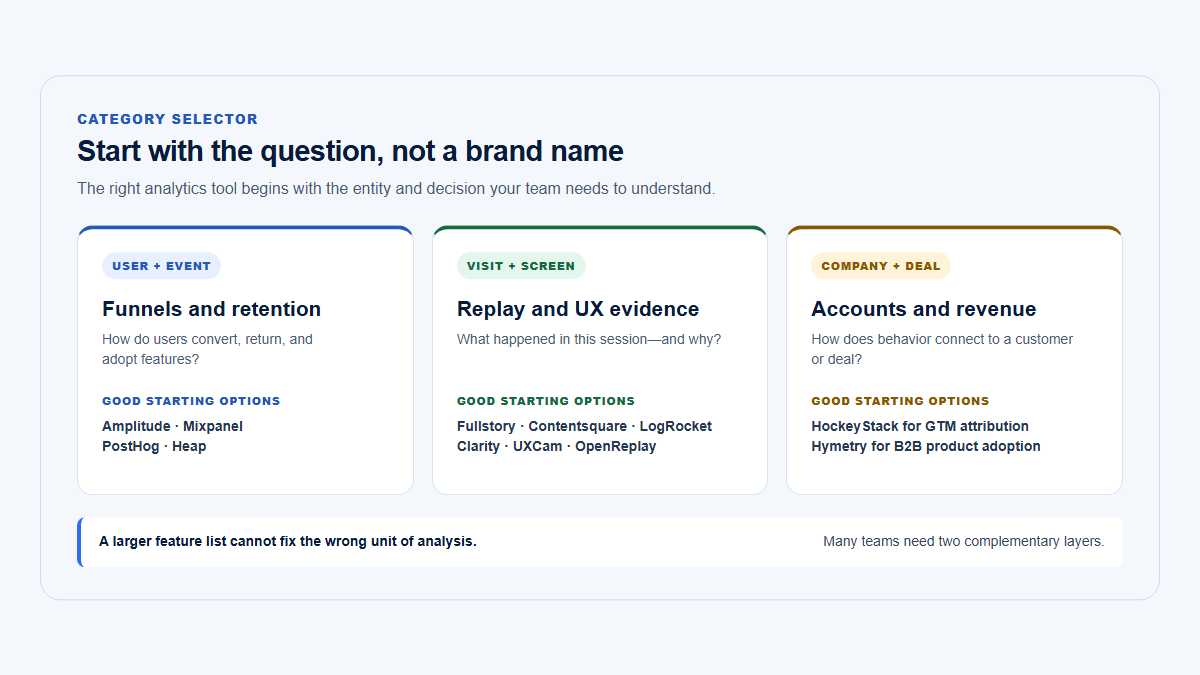
Hymetry is not a general replacement for these platforms. Its narrower focus is B2B account evidence: behavior by company, participation by user, product-area context through pages, and the visits behind a signal. It can complement a broad analytics stack when customer-facing teams need company-level adoption and visit evidence by default.
Keep authoritative server outcomes, stable identity, consent, and data minimization regardless of product. No hands-on test, customer outcome, performance result, or replacement claim is implied.
Frequently asked questions
Is Amplitude better than Mixpanel?
Not universally. Amplitude is stronger for broad governed analytical programs; Mixpanel is often the better fit for focused, approachable PM and analyst self-service.
What makes PostHog different?
PostHog combines analytics with replay, flags, experiments, surveys, error tracking, and data tools in an engineering-oriented ecosystem, with separate usage meters for many products.
Do all three support account analytics?
Yes, through package-dependent account or group features. Historical group analysis still requires the relevant group identifiers on the data.
Do all three include session replay?
Yes, but web and mobile allowances, SDK requirements, retention, and package boundaries differ. Account-level analysis also does not guarantee an account-aggregated replay view.
Which is best for experimentation?
Amplitude fits governed experimentation programs, Mixpanel offers experiments and flags as Enterprise add-ons, and PostHog fits engineering teams that want flag delivery and analysis in the same workflow.
Can these products be self-hosted?
PostHog has an open-source self-hosting path, but official documentation describes it as unsupported. No comparable public self-hosted application deployment was documented for Amplitude or Mixpanel.
Sources
Methodology: Capabilities were described only where supported by official materials available on . Official pricing and documentation controlled current feature and package claims; G2 provided a common ratings snapshot; video watch pages established titles, channels, dates, durations, and disclosures. Where documents conflicted, the conflict remains as a procurement warning. Review themes do not imply every reviewer had the same experience.
Amplitude official sources
Mixpanel official sources
PostHog official sources
Ratings and video sources
Additional references from the original article
- Mixpanel: Mixpanel Experimentation Feature Flags
- Amplitude: Identify Users
- Amplitude: Quickstart For Data Teams
- Mixpanel: Javascript
- Amplitude: Autocapture
- Mixpanel: Lexicon
- PostHog: Autocapture
- Amplitude: Heatmaps
- Mixpanel: Faqs
- Amplitude: Session Replay Android Standalone
- Mixpanel: React Native Replay
- PostHog: React Native
- PostHog: How To Control Which Sessions You Record
- G2: Reviews
- G2: Reviews (page 5)
- G2: Reviews
- G2: Reviews
- Amplitude: Plan Your Accounts Instrumentation
- Amplitude: Data Planning Playbook
- Amplitude: Data Planning Workflow
- Amplitude: Data
- Amplitude: Data Access Control
- Amplitude: Behavioral Cohorts
- Amplitude: Instrument Session Replay
- Amplitude: Build A Warehouse Native Data Model
- Amplitude: Snowflake Data Share
- Amplitude: Snowflake
- Amplitude: Google Bigquery
- Amplitude: Google Cloud Storage
- Amplitude: Common Patterns
- Amplitude: The Amplitude Quickstart Series
- Mixpanel: Id Management
- Mixpanel: Migrating To Simplified Id Merge System
- Mixpanel: Insights
- Mixpanel: Funnels
- Mixpanel: Funnels Advanced
- Mixpanel: Retention
- Mixpanel: Flows
- Mixpanel: Cohorts
- Mixpanel: Custom Events
- Mixpanel: Custom Properties
- Mixpanel: Saved Metrics And Behaviors
- Mixpanel: Javascript Replay
- Mixpanel: Android Replay
- Mixpanel: Swift Replay
- Mixpanel: Flutter Replay
- Mixpanel: React Native Flags
- Mixpanel: Startup Program
- Mixpanel: Amplitude
- PostHog: Capture Events
- PostHog: Identify
- PostHog: Actions
- PostHog: Funnels
- PostHog: Subscriptions
- PostHog: Cohorts
- PostHog: Metrics
- PostHog: Exposures
- PostHog: Mobile
- PostHog: Android
- PostHog: Ios
- PostHog: React Native
- PostHog: Surveys
- PostHog: Error Tracking
- PostHog: Sql
- PostHog: Expressions
- PostHog: Libraries
- PostHog: Flutter
- PostHog: Infra As Code
- scout7.ai: People Want Easy Product Usage Tracking
- product usage by company
- autocapture versus custom events
- B2B product analytics
- feature adoption rate
- peer baselines for B2B SaaS